The escaped criminal (or that's what I thought)
The third incident I encountered when coming home from town mid morning last week, and half way between town and the village is a lay-by, a bit of road that had been cut off when straightening the road.
In the lay-by in the distance was a parked mini car, an up to date fast one, and way in the distance coming from the village were three cars traveling at high speed. To my amazement they swooped into the lay-by
in close formation, the first one went past the parked mini and pulled up across the front of it, the second one, a marked police car pulled along side, and a third also a marked car boxed it in. All this would have taken about 30 seconds, and by the time I drove past the group the three policemen in full riot gear were out of the cars and leaning over the roof of their respective cars pointing guns at the driver of the mini car. He had a hood of his jacket well up over his head and face, so I could not see his face at all.
I would have offered them help or assistance, in whatever way I could, but with all the guns involved, I thought better of it and drove on home. However, a couple of hours later I went down and found the lay-by empty, so seeing as is one of my fields that adjoin that lay-by, very often things get chucked over the fence, and on a close inspection, I half expected to find a discarded gun or weapon. No weapon in the field, bit disappointing, and on close monitoring of the local news that night , nothing was mentioned about an incident in our area. Maybe a false alarm, or the bloke gave himself up without fuss, I will never know, but I just wish I carried my camera with me a bit more often, I could have been a reporter and sold me story to the highest bidding newspaper. All wishful thing.
Tuesday, 10 December 2013


Monday, 9 December 2013
The escaped Water Buffalo's 167
The escaped Water Buffalo's
In the village there is a fairly large herd of water Buffalo, a hundred or more, and just after dark about twenty escaped through a gate onto the road around milking time and made their way up through the village center among the houses and among the home going commuter traffic. With black animals in the dark and on a corner a car and a buffalo met, the buffalo broke the car wind screen and dented the roof and bent a door pillar, in other words it wrote the car off.
It was not long before they were all rounded up, but to anyone who is not familiar with Buffalo, they are reasonably placid, and if you encourage them with a stick too much, they will just lay down and not move, so patience and understanding is the byword when moving Buffalo.
In the village there is a fairly large herd of water Buffalo, a hundred or more, and just after dark about twenty escaped through a gate onto the road around milking time and made their way up through the village center among the houses and among the home going commuter traffic. With black animals in the dark and on a corner a car and a buffalo met, the buffalo broke the car wind screen and dented the roof and bent a door pillar, in other words it wrote the car off.
It was not long before they were all rounded up, but to anyone who is not familiar with Buffalo, they are reasonably placid, and if you encourage them with a stick too much, they will just lay down and not move, so patience and understanding is the byword when moving Buffalo.
Sunday, 8 December 2013
Exciting times (Nov Dec 2013) The escaped bull, 166
For such a small village , it has been livened up by three separate incidents that do not happen around here very often.
The first story here
The escaped bull
The first incident was a young bull that has been running about this general area for over three weeks now, it apparently escaped with thee heifer of the same age, about 18 months to 2 years, and some eight or ten hours later they were cornered in with a large dairy herd and penned up when they went down for milking.
The heifers were loaded up but the bull lunged over a gate bending it down and escaped. it went back to the "host" dairy herd, and after a few more hours of hopping over fences and gates they failed to corner it and was left grazing with 350 dairy cows.
The following morning it had disappeared, presumably back to where it had come from. One week later it was spotted way back in a wood, where it had been hiding, it adjoined the field that it had been grazing in with the dairy herd, it must have found a bit of piece and quiet food (leaves) and water but was still very nervous about even being seem. The owner brought up some feed for it and could not muster enough helpers to attempt another roundup, so another week went by and he was finally encouraged to walk down to the building with the dairy cows again. This time into a newly made cubicle shed, needless to say he was jumping about in there and bent a number of cubicle stalls and escaped back to his wood.
During the third week arrangements were made for a slaughter house man to come and shoot the animal in the wood and take it off. But not being able to get the correct paper work, and with TB restriction in place in our area, the slaughter house would not shift it. So now 22 days on its still living in the wood. A beast like that, that learns how to escape and jump and dodge, will never settle down in one field again, it will always escape, no matter what, so it will almost certainly have to be shot in the wood.
Will bring you up to date when that happens.
The first story here
The escaped bull
The first incident was a young bull that has been running about this general area for over three weeks now, it apparently escaped with thee heifer of the same age, about 18 months to 2 years, and some eight or ten hours later they were cornered in with a large dairy herd and penned up when they went down for milking.
The heifers were loaded up but the bull lunged over a gate bending it down and escaped. it went back to the "host" dairy herd, and after a few more hours of hopping over fences and gates they failed to corner it and was left grazing with 350 dairy cows.
The following morning it had disappeared, presumably back to where it had come from. One week later it was spotted way back in a wood, where it had been hiding, it adjoined the field that it had been grazing in with the dairy herd, it must have found a bit of piece and quiet food (leaves) and water but was still very nervous about even being seem. The owner brought up some feed for it and could not muster enough helpers to attempt another roundup, so another week went by and he was finally encouraged to walk down to the building with the dairy cows again. This time into a newly made cubicle shed, needless to say he was jumping about in there and bent a number of cubicle stalls and escaped back to his wood.
During the third week arrangements were made for a slaughter house man to come and shoot the animal in the wood and take it off. But not being able to get the correct paper work, and with TB restriction in place in our area, the slaughter house would not shift it. So now 22 days on its still living in the wood. A beast like that, that learns how to escape and jump and dodge, will never settle down in one field again, it will always escape, no matter what, so it will almost certainly have to be shot in the wood.
Will bring you up to date when that happens.
Tuesday, 3 December 2013
It was Winston (The Bull) 165
It was Winston (The Bull)
Have you ever been sitting having breakfast, when a bull looks into the kitchen window, well we did. It was Winston, our seven year old Hereford bull, it was June time and he had been on his own in a field behind the building for almost six months.
Way in the distance he can see other cattle and he was getting a bit restless, particularly after having a couple of months or more of good grass that has built up his body weight, until he is almost fighting fit.
So fit, that he managed to open his field gate and let himself into the stack yard, and gave the round hay bales a bit of a routing up on his way down to the back yard outside the house.

Just having the camera handy I took this picture of him through our kitchen window
just as he ambled across the lawn

He cross the path that leads from the wicket to the house door and into the corner, where he decides where to go next, giving me time to race out with the camera to take a few more picture.

He is reasonably quiet, and decides, this way,This was my vein attempt to persuade him to head back to his field, I was always of the belief that cattle not rushed about or driven will take the line of least resistance, usually uphill, even a strand of string will persuade them not to go through that way (more often than not).

But no, he decides to have a look through the kitchen window, and part the chairs under the porch where we sit and have a morning coffee break, then he paused for a minuet.
I thought at that point he was going to leave a message, as cattle invariably do, to mark his presence.

Then he moved on again without any prompting towards a narrow opening in the trellis, this he did by threading one horn through first then rolled his head and got the other through without smashing the opening, an opening that was stretched as the bulk of his body slowly went through.

Now fully emerged from the porch, you can see the straw on his shoulders where he had had a play with some bales on his way down.

Now between the bushes and chooses the narrowest pair to get through

This is the general area where Winston visited

And back across where we park the vehicles. Don’t know about you but I always look at what else is in a picture, particularly if it’s a farm yard.
First and most obvious is the land rover Discovery, then leaning up against the out buildings is a pair of corn drill wheels, it is what is left of the Massy Harris Combine drill that father had new almost sixty years ago, very up to date back then as the fertilizer was sown with the grain in one go.
It looks like a house broom had been hastily abandoned, and above the bull’s rump is the roof of the village school.
A Calf New Born
Its nice to go into the field, and find a calf new born,
They come along at any time, day or night or early morn,
Pains of birth alert the cow, find a nice quiet spot to lay,
Pushing hard till it appears, it’s over in a day.
Within an hour it’s licked and polished, up and had some milk,
Then off to find a place to hide, its coat as smooth as silk,
A bog of nettles, stalky grass, or just some rushes in a tuft
Keep its head down have a sleep, predators its out bluffed.
With plenty milk and summer sun, it plays and grows as well,
Mother gets fed up with it, but knows it’s hers by smell,
At summer’s end it’s parted from, its mother needs a rest,
Life of growing, getting fat, for meat, correct you’ve guessed.
Owd Fred
Although prepared for martyrdom, I preferred that it be postponed.
Sir Winston Churchill
Wednesday, 27 November 2013
Of all the things that we have changed
When you take on land or even a whole farm for the first
time, there are a whole lot of things to be changed or improved to bring it
round to your own way of thinking and farming. When I took this farm on we piped
in some mid field open ditches, made wider gateways between arable fields, save
taking the header off the combine when moving to the next field. Water troughs
and mains water pipe pulled under with a mole plough across to grazing fields,
which had been watered by springs, which dried up mid-summer time.
A great heap of soil
along the lower boundary where the headlands had been plough out of the field
off the top land, had to be pushed down further to form an extra acre or so out
onto the peaty edge of the fields involved.
Lower branches of hedge row trees were lopped to get
machinery under, with the coming of cabs and mirrors on tractors and the
combine it was essential to utilize the whole of the field.
My father used to send two of us lads out with a tractor and
a single furrow horse plough to get that two extra furrows closer to the
hedge.
Sheds for loose housing cattle were all made so the tractor
and front end loader could get in to clean them out, and back in my father’s
day when I was a kid, he changed all his cowshed from the old oak stalls and
blue brick floors to new pre-cast concrete stalls and smooth concrete floors
that could be scrubbed.
In my own period of modernization cows in stalls gave way to
cow cubicles and self-feed silage the cubicles being invented around 1960 and it would be almost 1970 when my own cows
were introduce to cubicles. Along with this the milking parlours came in and
bulk milk tanks, in my first abreast parlour we milked directly into churns
until the road milk tank collection started.
And so it is that now I am retiring, the new young and keen
farmer who is taking over the land I have farmed for the last forty five years,
he will modernize and model the fields to his pattern of farming, in his case
milking cows in a big way. I started with twenty six cows on ninety six acres
in 1960 building up to seventy two cows plus followers by 1985, then in the village the first
ninety cow herd and now 2013 a 350cow herd building up to 400 this next year. I
can’t imagine where it will all go in the next lifetime of farming up to the
2060’s.


Figure 2. On the left of this picture is the cowshed door with another pitching door for hay into the lofts


This shows the low sliding door
on top a churn stand where the milk lorry/truck would pull alongside to off
load his empty churns and load the full ones, behind is a continuation of the
cowsheds, in all there was stalls for 45 cows. These building have now 2013,
stood un-used for cows now for almost thirty five years, it is expected that
they will be converted into three or four houses, (for people, god help them).
Memories of how the
farm,
Looked when we first
arrived,
Of all the things
that we have changed,
N’ things for which
we strived,
The gates the fences
fields and sheds,
The land we plough
for crops,
Of all the weather
hail or rain,
The work it never
stops.
Owd Fred
Retirement
kills more people than work ever did.
Malcolm S. Forbes
Thursday, 21 November 2013
Road Run Fordson E27N and B250 tractors 164
Every so often around about our area someone or other organizes a tractor road run for charity in this case it was for their local church. We used to have a road run organized in the next village timed to be in between Christmas and new Years day but that one has now stopped, in a way it was a victim of its own success as over a hundred tractors took part every year come rain/snow sun and frost they always turned out, it took best part of half an hour for the stream of tractors to go through any point on the run.
Back to the run a fortnight ago, (October 2013) around fifty tractor turned up, this still took a good quarter of an hour for them to clear a road junction or other obstacle on the lanes.
It was decided that the oldest tractors would follow the lead tractor, with younger more modern tractors follow and bring up the rear, this was in case an old one broke down the others would be able to assist or tow the victim the remaining distance of the run.
I took two tractors, the first was the old Fordson E27N a TVO fueled tractor (Tractor Vaporizing Oil) the equivalent of this is what we use to heat our house, so that tank gets raided, but that fuel is too "dry" so we add a gallon of diesel to every ten gallon of "TVO". In fact when up to its working temperature it will vaporize and run on neat diesel.
As you may know or not know this tractor does not have a thermostat, don't think they had been invented when they designed these engines, so we have to manually lift and lower the blind on the front of the radiator.
For the likes of a road run it needs to be about half way down, in heavy work it would be all the way down, and as soon as you stop for more than five minutes, it essential the the blind is all the way up to keep it hot, if it cools it will not vaporized its TVO and will oil the plugs up and then be misfiring. When starting it from cold with a crank handle it starts on petrol
The second tractor I took was my old International B250, the one I drove from new back in 1956, 57 years old this was over hauled and sprayed up to almost new condition eight years ago,

The B250 was driven to the host farm some ten miles away, the Fordson had a lift on a trailer behind the Landrover. The road run was around thirty miles, both tractors run well, with the old International doing in excess of fifty miles that day.
Back to the run a fortnight ago, (October 2013) around fifty tractor turned up, this still took a good quarter of an hour for them to clear a road junction or other obstacle on the lanes.
It was decided that the oldest tractors would follow the lead tractor, with younger more modern tractors follow and bring up the rear, this was in case an old one broke down the others would be able to assist or tow the victim the remaining distance of the run.
I took two tractors, the first was the old Fordson E27N a TVO fueled tractor (Tractor Vaporizing Oil) the equivalent of this is what we use to heat our house, so that tank gets raided, but that fuel is too "dry" so we add a gallon of diesel to every ten gallon of "TVO". In fact when up to its working temperature it will vaporize and run on neat diesel.
As you may know or not know this tractor does not have a thermostat, don't think they had been invented when they designed these engines, so we have to manually lift and lower the blind on the front of the radiator.
For the likes of a road run it needs to be about half way down, in heavy work it would be all the way down, and as soon as you stop for more than five minutes, it essential the the blind is all the way up to keep it hot, if it cools it will not vaporized its TVO and will oil the plugs up and then be misfiring. When starting it from cold with a crank handle it starts on petrol
 |
| A before picture as it was when purchased |
 |
| After it had been done up, note the radiator blind is to the top |
 |
| Crank starting |
 |
| Starting out with rad blind half way down |
The second tractor I took was my old International B250, the one I drove from new back in 1956, 57 years old this was over hauled and sprayed up to almost new condition eight years ago,

 |
| This is both tractors at a spring road run a few years ago |
Needless to say the Fordson was the lead tractor (behind the host tractor showing us the way) as it was the oldest on the run at 67 years of age , (1946 vintage) it does a steady twelve miles per hour.
The weather kept fine with only a hint of rain as we started out but heavy coats and hatswere essential, especial to those younger tractor drivers who ar pampered by cabs and cab heaters.
Saturday, 16 November 2013
How life sweeps on regardless (autumn 2013) 163
This is now my fifty third winter farming and have had a
fair spread of all that the weather can do at you, be it summer or winter. We
have been through four or five foot and mouth out breaks with all the restrictions
and rules of confinement, unable to sell stock for months on end. The over
stocking that that brings, the shortage of fodder and unable to turn out stock
to out lying fields when spring eventually came.
Time and tide waits for no man, as the old saying goes, and life
goes on, it’s only as you get older that you realize how quickly it is passing
you by.
No sooner one harvest finishes and we’re into autumn with
the ploughing and sowing of next years crops. The suckler cows that calved in
spring have big strong calves following them, and back in calf for the
following year’s crop.
The mornings are starting to be foggy and damp, the
mushrooms in the meadows are starting to grow, the leaves on the trees just
starting to loose their colour, and crab apples dropping into the grass.
 |
| The village church of St. Chads in the distance dry winter fodder stored in the Hay Barn |
 |
| Looking from the church gate across the village green School on the left our farm house on right and the barn roof between |
 |
| Only part of the main stack of winter forage in wrapped bales |
 |
 |
| Grazing in the orchard village school behind the hedge |
 |
| Aftermath grazing on the meadows in October |
Big bales of hay all neatly stacked under the barn ready for
winter and the silage bales in the yard beyond all in black shiny plastic. The cattle are spread out onto the mow meadows
grazing the aftermaths while the drier wintering fields are rested ready for
the heavy trampling they will inevitably get later in the winter.
You can stop a clock but you cannot stop time, here are a
few quotes on time,---
Tradition is what you resort to when you don’t have the time
or money to do it right
Kurt Herbert Alder.
The trouble with our times is that the future is not what it
used to be.
Paul Valery (1871 –
1945)
By the time a man realizes that maybe his father was right,
he usually has a son who thinks he’s wrong.
Charles Wadsworth
We learn something every day, and lots of times it’s that
what we learned the day before was wrong.
Bill Vaughn
About the time we think we can make ends meet, somebody
moves the ends.
Herbert Hoover (1874
– 1964)
If we had no winter, spring would not be so pleasant: If we
did not sometimes taste adversity, prosperity would not be so welcome.
Anne Bradstreet (1612
– 1672)Wednesday, 13 November 2013
"Never set a man to do a job that you would'na do ya self" -- 162
I have now began to realize that a bit more thinking and a bit less doing, will give me a bit more time on this earth.
Take for instance , last week we had to have a TB test, the last test we had 2 months ago there was 4 reactors and they were sent for slaughter, which put our farm onto a sixty day test program until we have two or is it three clear tests.
During that test two month ago, the cattle being tested included a group of sixteen month old "calves" still suckling off their mothers, they have never been handled except for tagging and de-horning and a previous test when they were quite small. The cows had not been put in calf again (because of my imminent retirement from that block of land ) and the "calves" locally called stirks, or could also be called yearlings, however you want to describe them they were almost as big as their mothers , and delinquent, and off their heads when gathered into the corral. Talk about dangerous, my younger helpers would not let me into the cattle as escape was a matter of going over the top and quickly.
As I said four reacted and went for slaughter immediately, and after not too many minutes thinking the rest of that rough group were dispatched to market within the month. Loading the remainder did not go without incident, we had the lorry (wagon) driver trapped between a tractor and the corral wall, put there to give him an escape gap, problem was one beast decide to follow him and got wedged, it was not until I moved the tractor forwards that the animal and the driver was freed and the driver fell to the floor. To my mind I thought it was to be a paramedic job air ambulance the lot, but as it happened he jumped to his feet as if nothing had happened.
I, like my father always told me, "never set a man to do a job that you would'na do ya self", and that is now getting impossible to live up to.
Back to the test we had last week for instance, I was in with the cows (they are quiet to handle) in the corral "feeding" them down the race (chute as you call it over the pond) I turned around and tripped over a brick-end and fell face down in the grass/mud. Things flash across ya mind very quickly on the decent to the horizontal position, then it takes a while to actual realize whats happened, being owd and not too agile, it impossible for me to just jump up. Two of my young and helpful helpers came across though the cows and dragged me to me feet to resume the job of sending cows down the race. Embarrassing to say the least, but it reiterated what they kept telling me ta keep out of the cattle, leave it to them.
All the while it on me mind of fathers saying "never set a man to do a job that you would'na do ya self"
People forget how fast you did a job, but they remember how well you did it.
Howard Newton
Take for instance , last week we had to have a TB test, the last test we had 2 months ago there was 4 reactors and they were sent for slaughter, which put our farm onto a sixty day test program until we have two or is it three clear tests.
 |
The calves are all by our Hereford bull but the cows they're out of, are of different breeds hence the variety of colours.
And no these are not the ones that caused so much trouble when testing and loading
|
 |
How many of you can relate to the stance/ posture of this calf, it is the same one as in the picture above, not one to trifle with at close quarters unless in a properly designed crush.
|
During that test two month ago, the cattle being tested included a group of sixteen month old "calves" still suckling off their mothers, they have never been handled except for tagging and de-horning and a previous test when they were quite small. The cows had not been put in calf again (because of my imminent retirement from that block of land ) and the "calves" locally called stirks, or could also be called yearlings, however you want to describe them they were almost as big as their mothers , and delinquent, and off their heads when gathered into the corral. Talk about dangerous, my younger helpers would not let me into the cattle as escape was a matter of going over the top and quickly.
As I said four reacted and went for slaughter immediately, and after not too many minutes thinking the rest of that rough group were dispatched to market within the month. Loading the remainder did not go without incident, we had the lorry (wagon) driver trapped between a tractor and the corral wall, put there to give him an escape gap, problem was one beast decide to follow him and got wedged, it was not until I moved the tractor forwards that the animal and the driver was freed and the driver fell to the floor. To my mind I thought it was to be a paramedic job air ambulance the lot, but as it happened he jumped to his feet as if nothing had happened.
I, like my father always told me, "never set a man to do a job that you would'na do ya self", and that is now getting impossible to live up to.
Back to the test we had last week for instance, I was in with the cows (they are quiet to handle) in the corral "feeding" them down the race (chute as you call it over the pond) I turned around and tripped over a brick-end and fell face down in the grass/mud. Things flash across ya mind very quickly on the decent to the horizontal position, then it takes a while to actual realize whats happened, being owd and not too agile, it impossible for me to just jump up. Two of my young and helpful helpers came across though the cows and dragged me to me feet to resume the job of sending cows down the race. Embarrassing to say the least, but it reiterated what they kept telling me ta keep out of the cattle, leave it to them.
All the while it on me mind of fathers saying "never set a man to do a job that you would'na do ya self"
People forget how fast you did a job, but they remember how well you did it.
Howard Newton
Monday, 11 November 2013
Remembrance Day Service 10th November 2013 161

There cannot be many Remembrance Day Services that I have missed watching on television at the Cenotaph in London, with all the solemnity and honor that goes with it to remember the fallen soldiers over the last century.
As the TV cameras pan around during the ceremony and the march past, it always very noticeable, (that's if your looking) the stage at which the trees and leaves are at that line the street. This year the leaves were so green and fresh, more so than at any time in the last fifty years.
When we had our first TV and that service was first televised, even though it was in black and white you could always see how many leaves were on the trees, when we had had a few early sharp frosts the trees would be almost naked of leaves, this was the first thing that Mother always noticed.
It was my old mother who always did the weather forecast for the whole family every day right up till she died, looking at the old barometer that hangs in the house, watching which way the smoke blew when she lit the fire, watching the clouds and listening to the six am news and weather program on the radio. She advised us when to sow in the spring when to mow for hay, when to cut the corn (in UK that's wheat barley and oats), a whole mine of information centered around the moon phases as well.
So far this back end we only had a slight hint of frost on the 9th November 2013, up until now, the grass has been growing and the ground still relatively warm, and the ditches are only now beginning to run, the little rain we've had has now topped up the ground water.
Never, never, never believe any war will be smooth and easy, or that anyone who embarks on the strange voyage, can measure the tides and hurricanes he will encounter. The statesman who yields to war fever must realize that once the signal is given, he is no longer the master of policy but the slave of unforeseeable and uncontrollable events.
Sir Winston Churchill (1874-1965)
Saturday, 9 November 2013
Dialect spell checker, Didn’a Couldn’a Wouldn’a 160
 Sorry I have not posted so regular this last weeks or is it months, I have been a bit distracted in compiling some of my stories into a book, you could not believe how long it takes to proof read and then read again just to make sure when it goes into print, everything is how it should be.
Take for instance, its bad enough for me not being all that literate, and simple every day words that have two meanings do not show up on the spell checker, take coarse and course, I didna know which one to put in until it was pointed out to me by a learned friend of mine. Then of course/coarse there's me/my own dialect spellings, where if I write what I have on me mind, half the page would be underlined with spell checker lines.
So read what O'v writ if ya can, it's all "Queens English" in my part of the world, and as for putting phrases and paragraphs together I tend not to leave enough room for the reader (you) time to breathe, I was told at school some seventy years ago that a comer in a line of writing told you where to take a breath.
Didn’a Couldn’a Wouldn’a
Round here among, the country folk,
Words get shortened, as they’re spoke,
Didn’a and could’na and
would’na and should’na,
didn’t, couldn’t, wouldn’t, shouldn’t
Dun’na know weer, or how fur its spread ta.
Do not, where, far to
Appy ta try, tar rit it darn but,
Happy to to write
it down but,
Looks like none, are in a dictionary arv got,
iv’e got
With inna and wunna, and conna
om appy,
is-not,
would-not, could-not , I’m happy,
But conna git aat ov, saying things snappy.
Out of
Mustn’a and inn’a and occard, ov bosted my spell check,
Mustn’t, isn’t , awkward I’ve
broken
So modern are keyboards, with buttons on deck,
All of these words are of negative state,
Brought up with them, so change it is too late.
Owd Fred,
Thursday, 31 October 2013
New Book The Longest Furrow 159
For those who would like to read some of these blogs from a book, this is what I have had published, its called "The Longest Furrow" by Owd Fred.
You can find them on---- Amazon Books The longest Furrow --- in Google or any search engine, there are four Volumes now on sale with a fifth in the pipeline.
Locally I find that its the older generation that are interested, the ones who do not have a computer, and cannot read what I've written, at the moment they are being bought as a Christmas presents for grandpa or grandma.
It gives an incite how one individual (me) has lived all my life on the farm, I am second
of four, father was eldest of four, grandfather was one of eight, G.
grandfather was youngest of seven, G.G. grandfather was youngest of eight, and
my G.G.G. grandfather was born in 1753.
Out of the six generations of farmers, I and my father were
the only ones to benefit from the use of tractors.
.jpg)
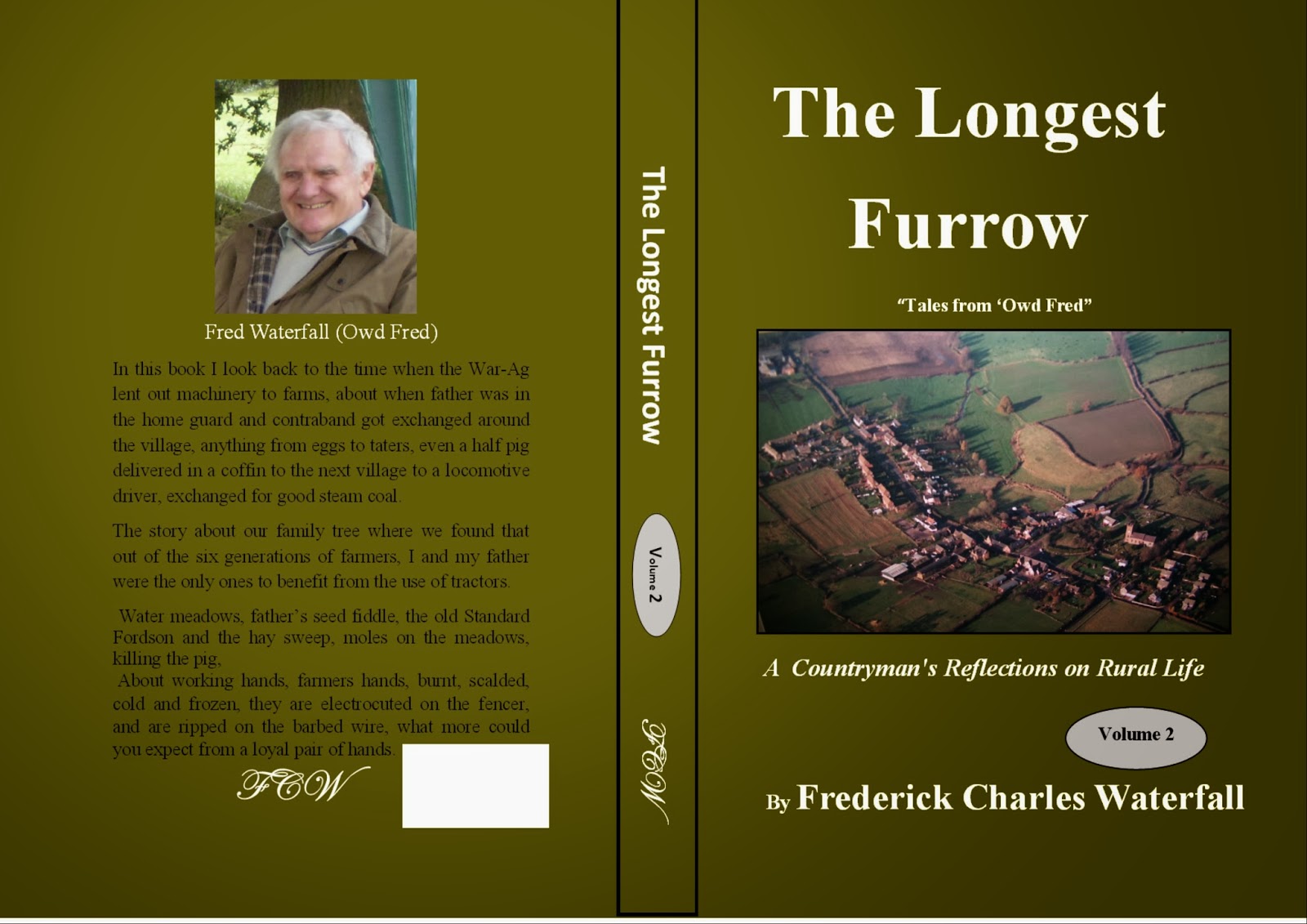
These books are being sold and money raised goes to a head injuries charity
Headways North Staffs.
The front picture on Volume 2 on the right is of our village.
Top left in the picture is Beeches Farm where I was brought up, bottom right is St Chads Church and just above left of its tower is Church Farm where I started farming and farmed for 25 years.
Bottom left in the picture with the white roofed farm building is Yews Farm where I have farmed (30 years) up to present day.
One thing I have never blogged about , and I do not intend to here, and that is the fact that we lost our only son who got fatally injured on our own farm yard at the age of twenty one, and it is the Headways charity
who do a wonderful job of helping those who have gone through such trauma and survived. We do our best to support them as they are all volunteers who run the Charity and are always very grateful of donations collected.
I am sure you will get as much pleasure reading this as I did out of writing and compiling the books.
Thank you in anticipation.
Fred Waterfall (Owd Fred)
Monday, 23 September 2013
The Blacksmith 158
Village Craftsmen - The Blacksmith
Up until the 1950's almost every village had all the regular craftsmen that covered all aspects of village life, from the nurse come midwife, to the wheelwright who not only laid out the deceased made the coffin and dug the grave, and pulled the four wheel hand pulled hearse, then made or repaired farm carts, made ladders, wheelbarrows,gates, and every thing in between. A brick layer on the estate maintenance a cobler who mended and made boots and shoes and made and repaired horse harness a shop keeper, a school , the vicar and of coarse the blacksmith, not forgetting the pub. There was nine farms that surrounded the village five of which were in the centre, all the farms milked cows, and around pm in the afternoon herds of cows walking on the village roads in all directions, to their respective farms from out lying day pastures. Two herds passed through the this ford every day

The Blacksmiths Shop around the 1950`s
Mr Giles travelled from Stafford to the village for two and sometimes three days a week; he also had a forge in East gate Street Stafford. With the number of horses rapidly declining it did not justify a full time blacksmith in the village. His main job was shoeing, welding repairing and fabricating gates and fences. Outside the blacksmiths shop was a heavy cast iron round disc, about 5ft across; to clamp wooden wheels down to while it was being hooped. To the extreme right ,at the chimney end was a tall narrow furnace ,the inside dimensions being only 18inches wide, but 6ft high and six foot long to heat up the wheel hoops to hammer them onto the wooden wheels.
This furnace had a crude steel door to make the draught draw under the gap at the bottom, and through the fire grate and up through the depth of coke, to provide the heat. The fumes joined the chimney that is still there to this day. This furnace had quite thick walls and an arch at the top, then a depth or sand on top to help keep the heat in a tiled roof to keep the weather out.
The original doors still cover the windows, but then they were just opening, never had been glazed. To the left of the double doors was a large pile of sweepings out of the shoeing bay, comprising of hoof trimmings and filings, dried on mud carried in the horse's hooves, and whatever the horses cared to leave behind. Through the double doors was the shoeing bay where the horses were tied up. Then through a door immediately on the right, the first thing you saw in the middle was the anvil, this stood on a large piece of elm log to bring the top of the anvil to about two and a half foot high, handy hammering height. To the left was a pile of worn out horse shoes, some with nails still in. On the right fastened to a bench was a metal bending tool to form the hoops for cart wheels, this could be adjusted to how tight the bend needed to be. The strip of flat iron would be heated then the end fed over the first roller under the second and over the third. A big cranking handle turned the rollers the middle roller was screwed down to put pressure to curve the metal. The next along the bench was a large blacksmiths vice; this had a heavy bracket along the front edge of the bench, and a leg down into the floor. A long shiny bar with a knob at each end to tighten it with, and well worn jaws that had gripped and been hammered for what seemed to be generations. Also on this bench in front of the second window was a pillar drill , this had a large flywheel that turned horizontally above your head and a crank handle to the side driving it, underneath was a huge chuck and a small vice to hold the metal while being drilled.
At the far end of the shop is the forge, this was made of bricks. At the front was an arch about eighteen inches high, by three feet wide with all sorts of scrap metal (useful off cut is the term I'm looking for) stuffed under for safe keeping. But the arch has a more practical reason for being there; it's for the blacksmith to put the toes of his boots under so he can stand closer to the forge without bending forward. The top edge of the forge the bricks had a rounded edge then nine inches in it was filled up with fine coke. The hearth was open on two sides, and bricked round on the other two with metal lining to protect it from the heat .Over the top was a metal hood with inches of dust on it leading into a brick chimney. At the back of the forge were the bellows, at one time, before I can remember he used the old bellows worked by foot pedal, made out of leather? These stayed there for quite a number of years, but got hidden by the "useful off cuts" but now the blowing was done by electric fan. All round the front and sides of the forge, except where he stood, were brackets holding all the tongs and tools of the trade. On the wall forming the left hand side of the hearth was his office; this took the form of a couple of nails with notes thrust onto them. One held the draughtsman's drawings of some fabrication job he had to do (drawn freehand on a torn off piece of cardboard full of thumb prints) one of many that had been put on before it. The other nail held an assortment of his wardrobe leather aprons jerkins and leggings that were in varying stages of dilapidation, the oldest at the back, right up to his older cap used when shoeing horses on the top. He had to reach just under this pile to operate the switch for the new electric fan.
First job when he arrived in a morning would be to light the forge, a few sticks that had been kept in a dry and warm place over night would be placed in a hollow in the centre of the hearth on a couple of sheets of crumpled newspaper. This was lit and the fan put on low, as the flames got enthusiastic some coke was gradually pulled over the burning sticks, and within a couple of minutes the fire was hot enough to boil the kettle. The fan was turned off and the fire would remain dormant most of the day, it being ready at a moments notice when switched on again. Along side the forge was a rusty dousing tank three quarters full of equally rusty water, where metal that needed cooling quickly was dunked in with a tremendous fizzling in clouds of steam, on the end of his tongs.
At the back of his work shop was a rack that held new metal of all dimensions, some for horse shoes some for cart wheel hoops, some for making gate hinges and all the ironwork needed when the wheelwright was making a new cart or wagon plus everything in between. This had to be reached by climbing over, jobs waiting to be done, things taken in as patterns and all the useful off cuts that might come in handy (should I say scrap metal). The only clear floor area was from the door to the forge and round the forge, then round the anvil.
Every so often they would fire up the furnace at the end of the blacksmith's shop for hooping wheels that Mr Clark the wheelwright had made or repaired. The hoops would be lifted out red hot and burned onto the wooden wheel that was clamped firmly on a huge cast iron disc that was permanently on the frontage of his shop. When hammered down into place firmly, water would be poured on to cool the iron hoop and shrink it tight onto the wooden wheel, these would then be rolled across the road and leaned against the wooden fence opposite, as many as twenty five of all sizes and weights ready to be repainted and refitted to there respective vehicles. On certain days of the week he would concentrate on shoeing horses mainly shires some cobs or float horses and a few hunters.
When our two remaining shires wanted shoeing we would be put up on top of them and set off to school, Mr Giles would lift us down to continue to school, then on the way home for dinner we would be pushed back on top to take them home again. Some times he would let us switch his forge fan on to heat a horse shoe, the shoe on the end of his tongs he would bury it in the centre of the burning coke for about a minuet, and it would come out more than red hot but going white hot with little sparks jumping off it. This would hold the heat while he burned it onto the trimmed hoof of the shire, this made the shoe touch the hoof all the way round and bed it in amid clouds of smoke. The shoe was then cooled before nailing it onto the horses hoof, the new set of shoes would last 6 to 8 weeks depending on the roadwork do. Old "Flower" one of our shires, had a habit of twisting her one back foot every time she put her foot down and would ware this one shoe out in a month, so an extra visit was necessary for that one foot every now and then.
I can still hear the ringing of the anvil as the blacksmith pumled the soft hot metal into the desired shape, after every blow to the metal he was working with there would be at least two smaller bounces of the hammer on the anvil creating a very sharp ringing, then two or three blows to the hot metal quite a dull sound. As the metal cooled to a dull red it would harden again and have to be reheated then the finer touches would be made turning it over and around until it reached the shape he wanted. It was a very hot job, sleeves rolled up and a heavy leather apron on, his cap turned slightly more than when he was cool and tipped back a little. Everything he used was shiny made so with the palm of his hardened hands that held the skill of many years of experience
The blacksmiths shop closed around 1975 as did the wheelwrights, horses had reached there lowest numbers, with no shires at all in this district, but riding horses and ponies are on the steady increase and mobile farrier are taking over. The demand for wooden carts and wagons gradually came to an end as tractors with hydraulic tipping became more popular.


This was the blacksmiths shop in 1945 when we were going to School. The tall narrow door on the right, was a furnace in which the iron hoops were heated red hot then hammered over the wooden wheel, which was clamped tight on the cast iron circle, permanently situated outside his shop.
I Remember Blacksmiths Shop
This was the blacksmiths shop in 1945 when we moved to the village and started school
I remember blacksmiths shop, all dingy dark and dusty,
Great big pile of horse shoes outside, all a going rusty,
Tom Giles was smithies name, all jolly strong and hot,
With shoeing father's horses, he did the blooming lot.
When setting off to school one morn, the horses we would take,
To blacksmiths shop for shoeing, would make us very late,
On going home for dinner, these horses we would ride,
Pitched up high on Flower, the others led with pride.
Welding cutting bending shaping, everything was there,
To make it new, or fettle up, to make a good repair,
His stock of metal had a rack, but most of it had missed,
It lay about in piles around his forge, which was in its midst.
All day you'd hear the hammer, a ringing out aloud,
Hitting out the red hot metal, made him very proud,
The different shapes and sizes, needed for a gate,
Lay around the workshop floor, no need for him a mate.
Alone he worked all day until; we kids came out of school,
Then he would be invaded, his metal then would cool,
On his forge he put his kettle, there to make some tea,
We kids tried out his drilling tool, great flywheel turned by me.
With tongs we tried to heat the metal, in the furnace hot,
To make and shape we would try, to bend on anvil, but,
Not hot enough to work it, so pumping the bellows up,
It made the spark fly every where, our school cloths covered us.
The water in the blacksmiths shop, was warm to wash our hand,
With dowsing all the things he'd made, red hot metal into bands,
With cloths soiled and singed, and not a hole in site,
Mother knew where we had been, said it's late it's nearly night.
Owd Fred
Education is not the filling of a pail, but the lighting of the fire.Quotation by W B Yeats
Wednesday, 11 September 2013
Farming on a peat bog 157
Farming on a peat bog (only part of the farm)
Almost a quarter of our farm is on a peat bog, at one time each of the farms in the village had a proportion of this peat ground, splitting and fragmenting the farms.In the last forty years as farms became vacant with retirements the estate amalgamated the farms into bigger units and got them into ring fence units. My farm being to the east side of the estate nearly all this peat ground fell into my circle on the map.
When I first started farming, and fresh from farm college, keen to try out new ideas, I had a small area of peat and some river side land as well, both areas prone to flooding once the river bloke its banks.
The peat grassland was full of buttercups and the soft rush, and when neglected the soft rushes became what we called ‘sniggle bogs' the centre of which rose up and made it impossible top cut with the old finger bar mowers.
So being keen I contacted my local MAFF (Ministry of Agriculture fisheries and Food) adviser. He was and old man who had had plenty of experience and seen these type of meadows before.
Being peat it was very acidic and no amount of lime would bring the PH levels up to that required by modern seed mixtures he advised. Best way was to improve the indigenous species of grass that was already growing down there.
First job was to rake or harrow the centre out of these ‘sniggle bogs' and if that did not work it was advised that I take some bags of Sulphate of Ammonia fertilizer and a bucket onto the meadows and place a handful of the fertilizer into the middle of each bog of rushes, the aim was to burn the centre out of the bog and the nitrogen fertilizer would benefit and encourage the surrounding grass.
After a couple of years these risen bogs had disappeared and the remaining rushes could be cut twice or three times a year with the finger bar mower. In later years, and as I took over more of the meadows the finger bar mowers had been supper seeded by the drum or disc mowers, and these were capable of cutting directly under and sniggle bogs cutting out the hand work involved in burning the centres out with fertilizer.
Back to the early days, once the meadows were mow-able, I started to leave a good proportion to cut for hay, it was before silage was invented in our area, and we managed to get the baler on to the meadows to bale the crop.
Confidence building and wishing to increase the yield of hay a complete fertilizer was applied and a tremendous response was seen from the old grasses that grew on the meadows, it was difficult to mow with the finger bar mower as there was a certain amount of rotting vegetation at the bottom of the sward so dense that it lacked sunlight. It was okay for the first one or two summers when the weather was with us, then we hit a bad year weather wise
It was mowed as usual and after two days was turned with an old ‘dickey swath turner' this flipped up just over half of the heavy side of the swath, a second turning the next day brought the rest of the swath to the top, it was at this point that the weather bloke and we had a very heavy down pour. A deluge that went on for most of the night, bringing the brook that run through the meadows to over flow, of course at mowing time of year, the brook and the river lower down were also weeded up which impeded the flow.
So it was the following day we watched with dismay, the water rose in between the heavy swaths, and later that day the swaths were actually floating and drifting to one side of the meadows. As the water receded so the swaths settled nice and neatly over each other each four foot swath now being four inches apart with overlapping. The whole crop was lost and that part of the meadow ruined for the next two years where the swaths lay and rotted down.
On reflecting back without the fertilizer, and with lighter crop that hay could have been baled a day earlier and the bales carted. That was imprinted on my mind for the rest of my farming days, however on the odd occasion we have had bales stranded and standing in flood water when rucked into piles of eight, only the bottom two were ruined and the other not up to much by the time they were carted. But that is the risk taken on these meadows.
Up to these modern times, the meadows are the same, we take the crop it produces usually towards August being the best time to cut, they are cut with a fifteen foot disc mower conditioner, wilted one day rowed up and baled in the following day or two days depending on the forecast, being big round bales these are loaded and moved without much physical effort on my part, that suit me fine, and stacked at home outside.
These ditches are bottomless, and the meadows mown leaving two metres uncut by the water course.
This type peat meadows now are getting rare and Natural England, the modern equivalent of MAFF have asked if they could monitor these meadows of ours and sent out advisers to study them. Some groups have been round from Nottingham University and now they are monitored and controlled by the Stewardship Schemes that I participate in.
Some of the principle rules that I have now got to abide by to maintain these meadows and receive a subsidy for doing so is,
1 Not to go on the meadows for any reason before 15th July.
This is so we do not rut and poach the ground; this is what I have already done over the last fifty years
2 Do not apply fertilizer or lime or farm yard manure.
Its impossible to get on the ground to spread FYM and as from experience no fertilizer or lime has ever been spread by me over the last fifty years. (Other than the few years explained above)3 Graze the aftermath growth of grass and remove stock by 1st November every year.This is what we have done on the meadows over the last fifty years.
4 The Ditches and dykes only to be cleaned of every third year in rotation.
Well that job is taken out of my hands, I have never done that job, it is undertaken by the River Board who clean out all the main rivers and water courses below a certain contour line. Never done that job over fifty years.
5 Leave two metres un-mown along side all water courses.
This is new to me, with the modern disc mowers you can only cut to the top of the bank or edge of the ditch, with the old finger bar mower you could hang the cutter bar down almost to the waters edge. The longest swath with the most grass is always the outside one. We loose out on that last swath of grass. So this rule is already catered for with the use of the disc mowers. Year 2008 was interesting in that I was approached by the Environment Agency, Natural England, they wanted me to go on a scheme Farming Flood plains for the future project.
They are looking at raising the water levels of our moor (peat) during the winter month. This they did by inserting some controllable dams in key sections of the ditches, and held the water at field level through to May when a sluice was opened in each dam to return the water level back to what was it natural levels. Below and above each dam was a censor, to measure the water levels by computer, and again censors out I the middle of the fields to register the water table again they connected to a computer to read the levels every few weeks.
All this work and altering the water table levels did not affect the crop of grass that we harvested at the end of July and August.
Conclusion, not enough infield standing water to benefit wading and wet land birds, so the dams were not closed in the winter of 2010, but the levels are still being monitored.
So it looks like I should be telling them how to maintain the meadows, and do like I have done for the last fifty years, but some folk just will not be told.
Another project was under taken on the moors when I was asked if the Wildlife trust could do a botanical survey of all the interesting indigenous species of plant growing on the peat. Apparently there are not many of these old untouched meadows left in the country, and this is what they found almost 40 different species.
Habitat: Neutral grassland: unimproved 29/05/2008 Recorder(s): -----(I won't name them here)-
flowering plant
Alopecurus geniculatus Marsh Foxtail locally frequent
Alopecurus pratensis Meadow Foxtail abundant
Anthoxanthum odoratum Sweet Vernal Grass abundant
Caltha palustris Marsh-marigold rare
Cardamine pratensis Cuckooflower frequent
Carex acutiformis Lesser Pond-sedge locally frequent
Carex disticha Brown Sedge frequent
Carex hirta Hairy Sedge frequent
Carex panicea Carnation Sedge rare
Cerastium fontanum Common Mouse-Ear occasional
Cirsium palustre Marsh Thistle rare
Deschampsia cespitosa Tufted Hair-Grass occasional
Eleocharis palustris Common Spike-rush locally abundant
Festuca rubra Red Fescue occasional
Filipendula ulmaria Meadowsweet locally frequent
Galium palustre Marsh-bedstraw frequent
Glyceria fluitans Floating Sweet-grass abundant
Holcus lanatus Yorkshire-fog frequent
Juncus articulatus Jointed Rush occasional
Juncus conglomeratus Compact Rush frequent
Juncus effusus Soft-rush occasional
Lathyrus pratensis Meadow Vetchling rare
Leontodon autumnalis Autumnal Hawkbit rare
Lychnis flos-cuculi Ragged-Robin rare
Persicaria maculosa Redshank locally frequent
Plantago lanceolata Ribwort Plantain frequent
Poa pratensis Smooth Meadow-Grass occasional
Ranunculus acris Meadow Buttercup frequent
Ranunculus bulbosus Bulbous Buttercup occasional
Ranunculus flammula Lesser Spearwort locally frequent
Ranunculus repens Creeping Buttercup frequent
Rumex acetosa Common Sorrel occasional
Senecio aquaticus Marsh Ragwort rare
Stellaria alsine Bog Stitchwort rare
Taraxacum officinale agg. Taraxacum officinale agg. rare
Trifolium pratense Red Clover occasional
Veronica serpyllifolia Thyme-leaved Speedwell rare
Vicia hirsute Hairy Tare rare
We were asked if one of our meadows could act as a donor meadow, to provide seeds to another meadow 20miles away.
So on a pre-booked day we mowed (mower without the conditioner we need the seeds to stay on the plants) and baled the grass/crop loaded it on their transport and by mid afternoon it was being spread on the receiving meadow, for the seeds of all the above plants to establish on a new meadow. Not had any feed back on the results but I imagine it will take a long while before it can be said to be successful.
Old Maps.
Its nice to look at very old maps, all faded and dog eared,
See what has change over the years, and what has disappeared,
Years ago they measured the land, all in furlong and chain
The length of a furlong a chain wide and an acre to attain,
Most roads and lanes are still the same, so are most the fields,
Village houses have increased built in corners quite concealed.
Countryman (Owd Fred)
Subscribe to:
Posts (Atom)