Thursday, 15 December 2011

Another old Village Charactor old Mrs. Blakmore.1948 87

She was the last to live in her old cottage, thatch had rotted away,
Half timbered filled in with brick, they were built that way,
Wattle and daub up the chimney breast, above the inglenook,
Cast iron range and chimney crane, hang kettle to boil on hook.


Churchyard Cottages.

The old thatched half timbered cottage that used to stand not fifty paces west of St Chads Church tower, was occupied by Mrs Blakmore. In my earliest memories her husband was still alive, but retired. Her front wicket was opposite the rickyard gateway of Church Farm. This ran straight up alongside the high hedge bank of the Church Farm garden, to her front door. The front door was the only door to her house, with a window to the left of it, letting light into the sitting room.

A small window to the right just round the corner let light into the scullery, where there was an old brown sink mounted on two pillars of bricks. Here the washing was done in her "Dolly tub", and the old "Mangle to squeeze the water out, before hanging it out on the line in the garden. The only other window was above the front door, to the only bedroom she had.

The old oak front door, made heavy by layers of paint, had a door latch that you gripped, and pressed the catch with your thumb, to open. On the inside it had a large bolt to secure the door; it did not seem to lock when you went out.

A new Yale lock was fitted, and it took the old lady some time to get used to it, in fact she walked out to fetch some coal one morning, and it blew too. She had locked herself out, my father who was working across the road, at Church Farm, fetched me from school, to squeeze me through the scullery window, to unlatch the new Yale lock.

On entering the door, you would notice a thick heavy beam, which stretched from the middle of the inglenook, to the left of the front door. Another equally large beam, which stretched all across the fire place to form the inglenook.

  Almost the length of this inglenook beam was a mantle piece shelf.  This had a strip of material fastened to the front edge like a pelmet, it was dark red velvet, edged with tassels, but in the dimly lit room, it was in fact very smoky light red. But it looked very impressive to my young eyes.

Other smaller oak beams stretched the other way to carry the floor boards of the bedroom. It had a cast iron open fire place, which had an oven to one side of it, and a chimney crane that swung the kettle over the fire to boil. In the left far corner, concealed by a door, to keep the draughts out was the stairs that twisted up round a single post directly into the bedroom.

In the bedroom, was a huge chimney breast, constructed of oak frame, filled in with wattle and daub. You certainly would not want to have a chimney fire.

Mrs Blakmore herself was a wiry and tough old lady, always very busy round the house, keeping it spick and span. Always a very alert and keen to talk to visitors, although she got very deaf in later years, and raised her voice to make sure you heard.

She wore her hair swept back over her ears to a bun at the back, and only wore her hat if she left the front gate. Every house wife of that era wore a pinafore, loop round the neck, and tied round the waist, usually of a floral pattern.

Among her regular jobs outside, was to chop the sticks, ready for fire lighting the next morning. This was OK until she started to loose her sight, then her daughter came every weekend, to chop a weeks supply for her. Another regular job was to fetch her milk, each evening, from Church Farm, soon after we had started milking.

A little bit of pacing up and down, if we were a little late, then we would send her home, [thirty yards] and ten minuets later take it over for her. At times, if the weather was bad, we popped over and got her coal in, and take her milk. Of course there was the standard outside loo, with the little job of maintenance that her daughter did at weekends; this was standard in all cottages.


The right hand half of the house is the cottage I have described, and the small brick and tile loo is bottom right of the picture. The two cottages were tied cottages, for the farm workers in the village, in this case Green Farm. The big tree on the right over hangs the lyche gate. The thatch started to rot away round the chimney and let rain in, and no concerted effort was made to repare it. The old lady died and when the new Council Houses were built in 1948, the house was pulled down. It had the very old "ships timbers" as the main frame in an inverted U, the oak was that black and hard, some was cut up years later with a chain saw, it made sparks come off the blade.


I Remember Old Mrs Blakemore

She was the last to live in her old cottage, thatch had rotted away,
Half timbered filled in with brick, they were built that way,
Wattle and daub up the chimney breast, above the inglenook,
Cast iron range and chimney crane, hang kettle to boil on hook.

A long shelf across the beam, above the fire place,
This was trimmed with a pelmet, with tassels there to grace,
Rich dark velvet it seemed to me, laced with smoke and dust
Ornaments of every size, for a house that's fit to bust.

Behind the only door she'd got, a round table made of oak,
Very old by the polished in stains, made it look bespoke,
One the shape of her door key, where it had been placed for years,
Cast its shadow from the window, it permanently appears.

Her stairs were in the corner, behind a curtain and peg for coats,
Went up steep, almost vertical, round a central post,
Into her bedroom by chimney breast, one rail to stop her fall,
In her only room upstairs it looked, just like a hole in the floor.

Had a scullery to the right, the side of her main room,
Had a brown sink on two brick pillars, small window mid the gloom,
Big old mangle to ring the cloths, dolly tub n' posher as well,
A greasy old drain to take waste, this was how she dwell.

Water was carried from the pump; up on the village green,
A couple of buckets a day, at times some in between,
A tap on the mains came late in life, brass one over the sink,
Now getting blind and losing her sight, not far go for a drink.

Out at the side a little brick closet, under an elder bush,
This was the loo with a wooden seat, old news papers used at a push,
Had to be emptied every week, deep hole in garden latrine,
That soiled over after a month, this was an old routine.

When she passed on, a chapter was gone, house roof fell apart,
It was pulled down to clear the ground, new house then to start,
All mod cons nothing left out, even the drive was paven,
Grass it round, plant some trees, it's now named "Glenhaven."

Countryman (Owd Fred)

Old houses mended,
Cost little less than new before they're mended.
Colley Cibber (1671 - 1757)

Sunday, 11 December 2011

Worms in the garden, and worms in the fields, 86

Earth Worms

Worms in the garden, and worms in the fields,
Eat all the rotted vegetation, improve all the yields,
Drawn down into the earth, a worm hole there to leave,
Pushing up the worm casts, a little pile of soil is heaved.


Earth Worms

Part of the ecology of the earth and soil that it is made up of is occupied by earth worms. These are only seen when ploughing or digging, this is when you see hundreds of birds following the plough. Worms eat through and draw down compost and dead vegetation into the ground often leaving the familiar worm casts. This gives a natural drainage and aeration to the surface of the land.


Some years ago as a side line to my farming, we had a wormery, breeding and rearing earth worms, for fishermen, and supplying them to gardener's to be put into garden compost bins. It was very interesting in that, you could use the natural instincts of the earth worm, in order to "harvest" them or separate them from their eggs.

Initially we bought five thousand worms as a starter pack, and introduced them fifty at a time into a peat / rotted horse muck mixture in plastic bins or boxes measuring 12 x 18 inches by 12 inches deep ( for metric modern folk its, 30 x 45 mm and 30 deep) this was then covered with a bit of old carpet to keep the whole lot moist. They were stacking boxes as used in offices and store houses, and the worms could be stacked three high on trestle tables up out of the draught and kept at a temperature of no less than 60F. Each week they were checked for moisture to see the compost was not drying out,

And after six weeks the fifty worms had "eaten" the rotted horse muck and the litter had to be renewed. Each box was tipped out onto a table, any worms exposed soon burrowed deep back into the pile, the litter on the outside of the cone was gradually scraped away driving the worms into the centre.


Repeating this a few times within a few minuets you are left with a pile of just clean worms all trying to get under each other away from light, forgot to say you need a bright light on above the table while doing this job as it makes them move even faster. The piles of fifty worms are put back into their boxes with new peat and rotted muck and the carpet replaced.

The spent litter, on looking carefully is full of eggs, this is put into a box double the size of that they came out of, along with an equal proportion of new peat/muck mixture, a piece of carpet placed on top and keep an eye on the moisture of the boxes over the next month or so. It's quite exciting to find your fist hatchlings so small you can hardly see them. After a few more weeks the young worms can be tipped out with there own litter into a main muck ruck, or compost heap if that's what you like to call it.

This again must be covered with a large carpet, or something similar, and every week taken off and add another layer of rotted muck. You can hose pipe spray on top of the carpet if it's too dry, and the young worms will eat their way up from the compost below up into the muck. After ten or twelve weeks the worms will be approaching adult size, almost ready to breed themselves.

There are a number of ways of catching these worms when they are ready for sale, you can spread a fine mesh over the litter before you spread the next lay of muck, only a very thin layer, and the mesh needs to be big enough for the worms to get through. Then replace the carpet and moisten in the usual way, after a few hours or perhaps the following morning most of the worms are in that top layer above the mesh. Remove the carpet, and rollup the mesh and some litter and nearly all the worms from that area, and tip them onto a table beneath a bright light, they will endeavour to get to the centre of the pile and what bit of litter you have on the table can be gently scraped off then.

For smaller scale harvest you can used a fine garden riddle with a bit of new rotted muck and place it on the surface under the carpet, you get the same results as described above.

If your main rearing bed is outside, the biggest problem will be badger's, rats and moles, they must be excluded, as if they once find your worm population, they will insist on returning every night. The beds can be of sleeper on edge round the sides as in a raised bed for gardening, instead if old carpet nowadays the top can be covered with bubble wrap and secured down round the edges.

Once the fishermen and gardeners know where you are and what you've got they can be packed in fifties in a handful of new peat in small plastic boxes, with air holes in the lid. They can be posted all over the country this way, (so long as you've got your money in your pocket first). The largest consignment was for a months fishing trip to Ireland for two fishermen, who called and picked them up on the way.

To get an idea of what to charge you have only to go to one or two fishing tackle shops and enquire as to what they charges for worms.
The spent worm compost is ideal for selling to gardener and nursery men as it is completely weed free and stone free, and most of it derived from what goes through the horses gut, then through the worms gut, when starting a new bed use about a foot deep of the old compost/litter as that is where they reside and gradually eat their way up into new rotted muck. Very little or no peat is used once they have establish their own "living" litter; peat is mainly used for the breeding boxes mixed half and half with muck.

Worms in the garden

Worms in the garden, and worms in the fields,
Eat all the rotted vegetation, improve all the yields,
Drawn down into the earth, a worm hole there to leave,
Pushing up the worm casts, a little pile of soil is heaved.

Repeated over a garden, or over acres in the grass,
Drawing down the cow pats, does it quietly without harass,
Moving in its little way, tons and tons of soil,
Millions of them working hard, their little bit of toil.

Owd Fred


To cherish what remains of the earth and to foster its renewal is our only hope of survival.
Wendell Berry.

Thursday, 8 December 2011

Moles and Meadows 85

Moles

Each spring that come along the moles start digging and pushing up soil in their inimitable way. Nearly always on the best bit of lawn, following in the hedge bottom then branching out under the grass in the most unpredictable directions. In the fields they work the same pushing soil up into mowing grass which inevitable get into the mown sward to contaminate the silage heap.

A bit later in the season when tunnels have got well established, you can see where the ground goes very hard, where cattle funnel towards a gateway or vehicles doing the same compacting the soil, they will have dug a tunnel across that way and its too hard to dig another. Father always said this will be like a trunk route where all the moles in that field will pass through at some time or the other, making it the prime place to set your mole traps.You are able to re-set the trap in the same place until all are caught.


The game keepers used to catch them and
 skin them they made very fine fir waist
coats out of them


Are these little chaps only found on the UK ?
Please let me know if you have them in countries beyond our shores

They are about four and half inches long with very powerful front feet


These Little Creatures Burrow

These little creatures burrow, and dig endlessly all day,
In total darkness all their lives, don't have time to play,
Every here and there they push, mound of soil up top,
In the most annoying places, n' nout to make them stop.

Their coat is fine and silky, and it brushes either way,
Because in tiny tunnels, shunt backward with no delay,
In good rich soil finding earth worms, catch them unaware,
To feed his busy little body, with no one will he share.

His feet are as little spades, to dig a longer tunnel,
And with his back feet shove the soil, up a little funnel,
This is when you see soil move, pushed up from below,
A mole is what I'm looking for, just to say hello.

Countryman


At one time we had a family of moles working there way across a low area of meadow ground, running into a substantial depth of peat. Every now and then we get a summer flood like we did last year, just after we had got all the silage bales away.

This one particular year we were in the middle of actually baling with the small conventional baler, and left the baler on the meadows. Over night there was a substantial down pour, and the ditches and the brook that they run into are well weeded up and it impedes the flow.


As you see from this pictue the ditch is well weeded up and the cattle tend to reach down into the channel for that tasty leaf of grass or plant just out of reach, but it is decieving an inch or so of clear water covers abot fifteen foot of peat. The crust of turf on the meadow bends with the weight of tractors and such like, then spring back up as you pass, and when the cattle come running up to you the whole area shakes like a jelly


So it did not take much for the meadow to flood, much to the annoyance of the moles. I went to retrieve the baler in about six inches of water, and to my amazement saw a couple of moles swimming for dear life in the wrong direction. Of coarse it was much too dangerous for me to follow them, as the area is dissected by deep drainage channels, the flood levelled the meadows off, so you could not see where they are.


This picture is taken from a bank on the edge of the peat, our meadows are in between the two woods, they have been mown mid July and aftermath is being grazed, the rough grass strips are the drainage channels which are weeded out each year in September by the river board for which we pay a drainage rate.


We have called cattle off those fields in flood from time to time, the older ones seem to sense where to go, but the followers, that years spring born calves soon find out how to swim, and swim towards the cows.
Our cows have all been born on the place and know not to get in the peaty ditches, learning as calves. Once one has been in the ditch, they never go in again, and remember that all their lives.
The calves can most often get out themselves, being agile and not too heavy, the evidence of which is a black tide mark up to a few inches from the top of the shoulders, although they must be counted twice a day and the ones that are stuck got out immediately.
It makes me wince when you see the firemen have been called out to get a cow out of a peaty ditch, a whole crew of men or perhaps two crews trying to get a fire hose under the belly of the animal. On the odd occasion when I have bought in a cow or in calf heifer, and they got stuck, I take an old cow chain and a length of rope and the fore end loader.

I put the chain round the cow's neck, attach the rope to it under the cows chin, and then fasten to the loader. Lift gently but firmly, and start moving back, the cow's neck looks long at this point, but don't worry it will hold the whole weight of her body. Once out they stand up in a daze, it gives you time to detach the chain and rope. The whole operation, one man and tractor, ten minutes at tops. Never lost one using this method, or pulled its neck out, but a horse I am told by the old men of the village would soon get a broken neck.
I was told that before the days of tractors the way was to take the old iron wheeled muck cart, the ones with five foot wooden wheels, back it up to the ditch and remove the horse from the shafts.

Lift the shafts skywards until the rear of the cart is in the grass. Rope or chain round the cows neck, or in them days round the horns, and threaded up over the front of the cart and tied to the shafts. I know there was always more men about back in them days, so about four men were able with a bit of luck pull the shafts down to the ground, and a man on each wheel wheeled the cart forward thus extracting the said cow,( not dead) cow.

When we first had a Fordson tractor and the next four tractor generations of tractor as well, they had no cabs and only later did we have one with a loader fitted. The removal of a cow from the peat went like this. Reverse up to the ditch, hitch onto the cow as described before, and feed the rope over the top of one rear tyre and tie it off down the far side. It is important to be dead in line for this, and someone with a hand on the rope easily guides it over the centre of the tread, and gently drive forwards.

 The whole reason for this lifting as opposed to dragging, is that a cow dragged will put her from legs out straight in front to pull against the rope and push her front legs under the turf bank into the soft peat and anchor there, that would be a good time to pull her neck out.
So lift and pull is the name of the game, this is made a lot easier with the modern four wheel drive loaders and tractors.
I think I could give tuition to the likes of the fire men, but as so often happens, their chief know best how to make it into a whole days work for eight or ten men and couple of appliances and maul the animal half to death, creating vet bills on top as well. You see the result of there work on the evening news or in the weekend papers, most of which could be avoided.

Not being critical, its just practical experience, its costly if you get it wrong, and as a farmer, if it hits you in the pocket, it is remembered for ever.


If there comes a little thaw,Still the air is chill and raw,Here and there a patch of snow,Dirtier than the ground below,Dribble down a marshy flood,Ankle deep you stick in mud,In the meadow while you sing,"This is spring".Christopher Pearce Cranch A Spring Growl

Saturday, 3 December 2011

The British Hedgerows and Boundaries. 84

The fields both large and small have names, you wouldn't dream exist,
Some relate to owner past, and others the type of land persists,
Hanging Bank is most sinister name, it's a cold north facing bank,
More research into this is what's needed, but all we've drawn is a blank.


It seem most important to British people that their Boundaries are marked by a fence or ditch and hedgerow or both. It is also important to know who's responsible for its maintenance and repair. On farms it is your own responsibility to keep your own cattle contained within your boundary.

Having said that, in the early days you marked your boundary by digging a ditch along your side of the line, and throwing the spoil back into your own side, then plant a hedge on top of it. In other words it's your boundary if the ditch is the other side of the hedge or fence. Internal ditches were often dug and a hedge planted, to pick up springs and tile drains that crossed the farm, and clear storm water to prevent shallow pools forming, which would kill the grass after a few week submerged.

Very old hedgerows are often made up of many species, ranging from Hawthorn and Blackthorn to Brier and Elder, the latter two being not very desirable, as livestock tend to eat through them. Unless the hedges are trimmed each year they soon become open in the bottom, and very loose in the top. Hawthorn and Holly make a good tight knit defence against cattle, but can soon become gappy when Elder which is a quick grower becomes dominant. Then when livestock are turned into the field, they eat it.

In one of our hedges, a botanist counted over twenty different species of hedgerow plant in a hundred yard stretch. This is a hedge that had evolved over the years in a grazing pasture, where cattle have made their contribution to pruning. Only the less palatable species dominated and maintained quite a good hedge.

Often the best trees to grow from saplings are the ones that are growing in the hedge bottom, when they appear out of the top of the hedge they can just be cut round and simply left to grow. No problem of transplanting or guarding they grow on to make splendid trees with no setbacks.
Hedgerows are important to birds, for nesting and for berries for winter feeding, and the hedge bottom, is shelter for a wide range of small mammals.

The ideal hedge, I was told, over fifty years ago, should be A shaped, and when in full leaf sheads rain like a thatched roof. This gives maximum shelter to its inhabitants, and a wide and dry undisturbed hedge bottom, , and a build-up of dry leaf mould, for hibernating wildlife like Hedgehogs and Toads. Rabbits like to burrow under hedges, as very often the soil is relatively loose and not too compacted, the roots of the hedge also hold the burrow open, and no danger of collapse. Also growing on top of a small hedge bank, it is well drained and dry.
  Badgers often dig in old rabbit warrens, particularly if they hit a good seam of sand that is just below a hard gravely layer. Here they can dig rapidly forming great mounds of sand that could turn a tractor over, if you're not concentrating.

Field mice and voles find shelter in the hedge banks, running among the tussocks of grass. At harvest time they venture further out in the field margins foraging for shed grain, where they fall pray to the kestrels and buzzards. When they spot a mouse, they hover then dive, carrying them off in their talons, owls too like this type of habitat.

On our estate fifty years ago, the woodman when needed would cut down an oak tree. The main trunk would be cut into a 5ft 6in length and 10ft length and multiples of that to make best use of the tree trunk. These large sections of tree trunk were then cleft (split) with wedges and a sledge hammer to make fencing posts and the longer ones into rails.
This practice is never used nowadays, but cleft timber was always better and stronger than sawn timber. This was because split timber always followed the grain of the wood, and sawn timber inevitably crossed the grain somewhere along its length and could break in that place. There are still examples of cleft posts and rails in parts of the estate but they are getting few and far between.


In the Moor Cover wood there always used to be a section in the lower part of the wood that was coppiced. The stools that had been harvested two or three years before were again ready to be cut. The most common use was for hedge laying stakes, and the whippy tops used to bind the top of the laid hedge. When completed this binding would look like the top edge of a basket, holding the light stakes and laid hedge stiff, durable and stock proof.

 Another use of the lighter stakes was for thatching pegs, these needed to be about 2ft long the thicker ones would be cleft into two, they would then be sharpened at one end to make it easier to push into the stack of hay or corn. The brash left after coppicing found it way into many of the village gardens as pea and bean sticks, and no opportunity was lost on finding a new seven or eight foot cloths line prop with a natural forked top.


Field Names of Seighford

Out in Britons countryside, looks like a patchwork quilt,
Of roads and lanes and field tracks, evolved and some were built,
They lead from towns and villages, and farms, map nailed on beam,
Each field a hedge and ditch and gate, watered by pond or stream.

The fields both large and small have names, you wouldn't dream exist,
Some relate to owner past, and others the type of land persists,
Red Rheine's is one of these mean fields, when ploughed reveals red clay,
Unless the frost into it gets, no seed bed though you work all day.

Best known one I've no doubt, behind Yews farm is Cumbers,
Ten houses built along the village, take that name and numbers,
Down by the ford is Mill Bank, four acre few trees by the brook,
The Hazel Graze another great name, nut bushes to make a crook.

Fosters by the railway line, named after a soul long gone,
And Pingles also down the Moor Lane, that defiantly is a mystery one,
Noons Birch is the most beautiful name, one that congers' you mind,
Public Field it was part of the land , run to the pub up back and behind.

Hoble End is another nice name, where two cottages stood in the fields,
No track did they only footpath, lonely place only a well and concealed,
Moss Common a field where the ditch, springs in the middle to pick up,
It is important that they are there, to water the ewes and the tup.

Ash Pits are three fields in a row, the Big the Middle and Little,
Ash trees are the obvious reason, and only one pit in the lot,
Hanging Bank is most sinister name, it's a cold north facing bank,
More research into this is what's needed, but all we've drawn is a blank

Lanes to the fields also have names, Moor Lane runs way from the ford,
Connecting with that is Love Lane, a grassy rut track half way Bridgeford,
The Oldfords Lane goes up to the farm, to Coton not a short cut by car,
And Smithy Lane runs way through houses, the shortest of all by far.

Moss Lane is one that runs eastwards, cow lane that it is can be seen,
Grass up the middle and is long, see cattle grazing fields so keen,
It has path that runs up it, and gates shut on each end,
The path is quite long; it comes out near Doxey on bend.

Countryman


See also my recent blog Post and Rails of Oak. Tag "Fencing"


If we had no winter, the spring would not be so pleasant, if we did not sometimes taste adversity, prosperity would not be so welcome.Anne Bradstreet (1612-1672).

Sunday, 27 November 2011

What we were doing 50 years ago 83

Just been looking back in the old farm diary on what we were doing just fifty years
ago today


This is the relavant page fifty years ago today 27 Nov 1961
It seems we were clearing out an old open fronted cart shed to put a gate on the front and a hay cratch on the wall at the back, in order to inwinter some young stock
That week we had got a contractor in pulling in plastic water pipe with a mole plough, plastic water pipe had only just reached farm level around then I remember they cut a thread on the end of the plastic pipe, put an insert in and screw the brass tap directly onto the plastic as if it were iron. NEW NEW NEW.


This was the nearest they had to a cattle crush, and note the cattle, young stock all had horns, the cows would be tied up in the cowsheds by the chain. There are a few horses in the back ground.


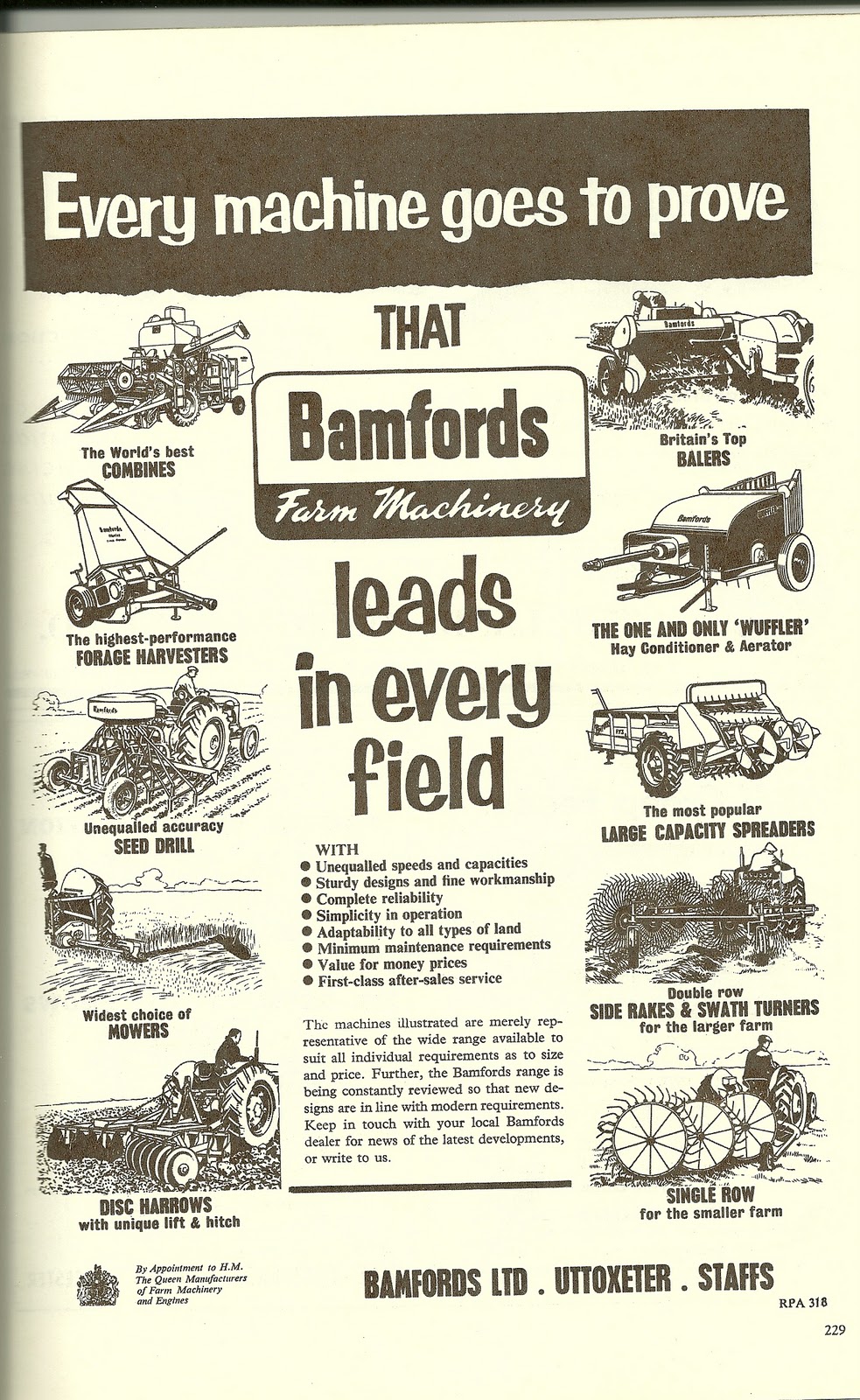
Bamfords were a leading farm machinery makers back then, disc and drum mowers had not been invents then, still with the finger bar mowers. The gearless spider wheel, see bottom two pictures on the right of the above advert, had not long been about.
The muck spreaders were land wheel driven.
Tractors had no live hydraulics, when you dipped the clutch the PTO would stop

These are the new Massey Harris combine drills brought out around that time they planted the grain and fertilizer along at the same time, father bought one and pulled it with his Diesel Fordson Major.
At a later date they fitted them with tractor rear tyres (Fergy back wheels). I still have four of the old steel wheels about the garden as ornaments


This is the page marker thatv come with the diary


This is a calculation done on the back of the page marker, in long hand before we had calculators, I checked it with my calculator today and its spot on, don’t know what I was working out at the time.
Any ideas anyone, we had never heard of Hectares back then

 I doubt if school childen, or older school age kids would know how to do that calculation nowadays. Tell me if you do and I will appolagise

Owd Fred


Tom Abbotts, Best loved Village character born 1887 --- 82

Tommy Abbotts


All the years I knew him, he always had some wit,
Smoked a pipe and chewed tabaca, and showed us how to spit,
He had a bike sit-up-and beg, handle bars reached his chest,
On Friday went to town on it, his hat he wore his best.

These are characters of the village nearly all of whom worked about the farms, few if any traveled out to other parts for work. This is what I remember of Tommy Abbotts in the 1940's when I was a lad growing up.

An old man, when I was a kid growing up, I can picture him now.

Tom Abbotts

Tom was born in 1887 and his sister Nellie in1893. A as far as I know, they had lived in Seighford a long time, possibly all there lives. They lived in the back half of the large house, on the left on the way up to the airfield. The house had two fields that adjoined his garden and buildings except for the little cottage that stands back off the road not a couple of yards from Tom's house.

He was an old man, when I was a boy in the late nineteen forties, and worked round the different farms in the village; He kept two house cows to provide milk butter and cheese, and reared half a dozen calves. These he then grazed on one of his fields, The other field he kept shut up in the spring for hay. These fields ran up to Bunns Bank and along to the next bend on the road onto the airfield the down almost to The Beeches Farm rickyard. In total he must have had about ten acres, together with the small range of buildings that are along side of the road, the ones with the G P O letter box.


‘Owd Tummy' as he was often called locally, was about five foot nine. He would stand with his right thumb in his waistcoat pocket, his left hand giving his pipe undivided attention. His feet would be at ten to two, and his weight evenly on both feet with his knees just forward of being locked (as you would stand in an earthquake). He had a slight hump on his shoulders, and would carry his head be in the forward position as though ready for milking? This was his regular stance when looking at the cattle or when in deep thought, and when talking to neighbours.

His face was always the same, a nose slightly narrow and pointed, and no extravagant expressions, almost what we call pan faced, But he only smiled with his eyes, I expect the pipe balked a big grin (?). His dark wide open eyes always seemed to sparkle, maybe because they often seemed to be wet, a good laugh and out with his hanky out of his pocket to dab them. Round his neck he nearly always had sweat band, to call it a ‘'neckerchief would be too posh and a cravat posher still. I've no doubt it was a habit from in the days when he used to break into a sweat. But these days he was a man who could pace himself and work at his own speed.


Quite a slim man in his time, but in the years, I knew him his trouser waist band had been modified by his sister Nellie, to cope with his expanding midriff, So discrete was this adjustment, that you could only see it when he bent over forward with the wind behind him, to blow his jacket up. She had cut the middle seam down the back of his trousers from the waist band about four inches, then the bracers buttons were put on the point of the opening, the fork of the bracers holding everything together comfortably.
 His trousers were of a coarse tweed, and charcoal in colour with matching waste coat and jacket, clean but well worn, and modified as the years went on. The jacket had leather patches on the elbows, and a strip sown on round the cuffs.
The waistcoat was not outwardly modified but had stretched to the figure it contained, if anything had been done, it was ten or so buttons may have been brought up to edge of the material. A watch and chain stretched across the waistcoat into one pocket, the matches in the other, and tobacco pouch in his inside jacket pocket.

 On the few occasions that his pipe was not in use it was stuffed in the top pocket of his jacket. More often than not it was in his teeth with his left arm hanging off it, with his first finger hanging over the bowl always ready to pack the tobacco if it went out.

He always had the same tobacco. It was twist (to me it looked like a stick of liquorish) which he cut a chunk off and rubbed in the palm of his hand before replenishing the pipe. The times when he was working with both hands, he would cut a chunk of baccy with his pocket knife, pop it in his mouth and chew it. Every now and then he would have to eject some tobacco juice, with a long ‘per-sqwit' which if it had been aimed to go somewhere. it always got there in a long unbroken stream..

He always wore boots, not a heavy type, but lighter sorts that would be polished from time to time. They had about ten lace holes and went well up above his ankles, almost to the calf of his leg. On working in the fields when there was mud about, he would wear some older boots and leather leggings.

To get about to fetch supplies and go to other farms, his only form of transport was his old bike, an old sit-up and beg type with rod brakes, twenty eight inch wheels. The handle bars were almost up to his chest when standing by it, and the seat as low as possible. It had a full chain case, and a carrier with a spring clip that would hold his mac in case of rain, and around the hub of each wheel, inside of the spokes, was a loose small leather strap ( like a small dog collar) to keep the hub bright and clean.

Each Friday he would go down to Stafford for his shopping, which was carried home in a carpet bag slung on his handle bars so deep was this bag that it hung right down to the middle of his front wheel. It certainly looked like a piece of carpet folded into two and stitched each side and with two cord handles which hung on the handle bars. It was flat and hung flat. Even when full it still hung flat. The only reason for going was to pick up a joint of beef from the butchers, and have a look in at the Sun Smithfield cattle market.

From the back door of the house you turned right , then left round the pear tree and another ten yards, you would be in the loo. A wooden seat with a bucket type, that had to be regularly attended to. (Emptied). A deep hole would be dug in the garden, (it resembled a bear trap only with no twig on top, would hate to have fell in there in the dark) and this would last about three months, filled over and then a new one dug.

Next to the loo was the pig sty, which most village houses had as standard, A single piglet was purchased when it was old enough to be weaned. Weaning took place when the sow was getting fed up with them, and the piglets would start chewing instead of sucking, and were eating in the trough with their mother.
They would be fed on all sorts of house hold scraps like potato peelings, outer cabbage leaves and stalks, and only topped up with pig meal purchase from the corn merchant. On reaching maturity, the butcher would call and kill the pig and the flitches of bacon and hams cured by salting , These would be hung in a cool room in the house with a muslin bag over to keep the flies off.


Most of what they ate was home grown in the neat but large garden. , Everything would be preserved for winter. Potatoes and carrots dug and hogged, beetroot boiled and pickled, runner beans picked, sliced and salted, and packed in stone jars, plums and pears picked and preserved in kilner jars. Eggs were preserved in glycerine to seal the shells, would keep up to four months; eggs were also hard boiled and pickled. The only thing they bought seemed to be salt, coal, beef and bread. They kept about twenty hens in a large run behind the pig sty , and it would be disaster if the hens got loose in the garden, these were kept for eggs and for eating.


All the cattle were reared from calves by Nellie, named and thoroughly spoiled; they could almost milk them in the middle of the field ((hand milked into a bucket). When it came to sell them, it was more traumatic than they let on, it was as if one of the family leaving home for good.

On a large proportion of the garden Tommy grew mangols (mangol wursels) .These were pulled and topped and taken into one of his sheds to protect them from the frost, to feed to the older cattle through the winter.
 Hay was the other main feed; this was cut in early July by one of the neighbours who he had worked for during the spring, quite often my father. The hay would be turned and tedded with great care for four days, and if the weather held good, father would bale it. This would be after 1958 when balers first came out before this date it would be carried and stacked loose.

Us lads, and the cow man and the Wagoner (now called the tractor driver) would all go round, cart it and stack it in his yard , Tom would do the supervising in the pose I described above Nellie brought the large enamel gallon jug of tea, with a handfull of cups and mugs. Everyone with cup in hand held steady for Nellie to pour out the welcome tea Philip the cowman had a sip, and as Nellie and Tom turned away round the stack Philip dashed his tea under the hedge. On her return Nellie topped his mug up again, Philip thanking her and complimenting her on the tea, but the same thing happened, it was dashed under the hedge again discretely.

My brothers and I saw all what went on, and when Nellie had collected up the cup and had gone back to the house, we enquired why no tea? Being an experienced cowman, he had observed that the only cow Tom had in milk at that time, had only calved the day before. That meant that the rich creamy tea had been made with beastings, this he could not stomach. Nellie being very thrifty, in her mind had made a good milky brew.

Beastings are produced by the cow for the first four days of lactating and they contain antibodies to protect the calf. They are extra rich to nourish a new born calf from birth. If beastings from the second milking are put in a large flat basin and put in the oven to slowly cook on low heat for an hour and a half, with a bit of nutmeg on top it comes out set like custard . Very nice hot or cold for pudding, and very popular with us kids (but not in tea)

Tom and Nellie were very private people, very few went into the house. It was like stepping back in time, even in the 1950`s. Then all of a sudden they bought a television and a long tall aerial was mounted on the tallest chimney.
As they got older they gave up the land and sold the cattle .The garden was getting too much for him, cultivating it less each year. Then in 1963 at the age of 70, Nellie died, Tom had relied on Nellie for the cooking and washing, and coped on his own remarkably well until he was finding it difficult to get about especially in the winter months.

The neighbours were alert to his situation, and someone called on him every day to do his bit of washing, get the coal in and chop the sticks for fire lighting etc. He had no immediate family as neither of them had ever been married. The only relatives lived a long way off. Then in 1977 Tom died at the age of 90.

He remained cheerful, and great fun to all who knew him. He had been like this all his life. He was a man who never raised his voice or lost his temper, a very shy man with strangers. A man of few words, and good listener. Although his face did not show it, he was a very jovial man who enjoyed a good joke, but seldom did he ever tell one.

His grave was dug and the coffin made by the village wheelwright and his brother, Jim and Bill Clark, as was Nellie's. Bill was grave digger and Jim made the coffins. Tom and Nellie's grave is near the top step of the back lane path of St 'Chad's church, among other old characters and residents of Seighford.

I have written two blogs about the village wheelwright some months ago, click -- ,


Owed Tom Abbotts

Owed Tom Abbotts lived in a cottage, with his sister Nell,
They kept three cows and calves, and a few old hens as well,
Cattle grazed across four acres, the rest was mown for hay,
In his garden he grew his mangols, fed in short winters day.

He helped his neighbours, when they're short handed,
With drilling hoeing weeding, with others he was banded,
At harvest time he stacked bays, till in the roof was bound,
Longest ladder then was cast, him get back to ground.

All the years I knew him, he always had some wit
Smoked a pipe and chewed tabaca, and showed us how to spit,
He had a bike sit-up-and beg, handle bars reached his chest,
On Friday went to town on it, his hat he wore his best.

His shopping bag hung on his bike, a long carpet bag it was,
All stitched up on either side, flat by front wheel because,
When it was loaded it was safe, hung by strong loops of cord,
Should it be carried in his hand, it almost dragged with the hoard.

As a young man stood up straight, he'd be all of five foot eight,
Old and stooped and round of back, shorter still as life dictate,
Feet a splayed for easy stance, and knees a slight of bend,
One thumb hooked in waist coat pocket, tuther to pipe distend.

He always had a cheery smile, his eyes were almost closed,
When he had a dam good laugh, tears ran down his pointed nose,
His face was brown and ruddy, from working in all weathers,
On his nose and chin could see, red veins mapped his features.

On his feet were black boots, well up above his ankle laced,
His trousers had a gusset, hold his expanding tummy braced,
It was a different colour , and could see when he bent over,
And buttons of his bracers , straining hard to cotton anchor.

Waistcoat matched his trousers, a suit some point decide,
Ten buttons some were missing, four pockets two each side,
One it held his pocket watch, secured to button hole with chain,
Another held his match box, England's Glory was it by name.

His jacket didn't quite match, been stitched around the collar,
Pockets drooped like open mouth, weighed down as if to cower,
In one was his bacca pouch, top pocket reserved for pipe,
Pipe was mostly in his mouth, not always did he light.

He carried a little pocket knife, his baccy Twist to cut,
When he rubbed it in his palm, into his pipe he put,
With cupped hand around his pipe, he lit it with a match,
Puff and suck till it was lit, mid curls of smoke detach.

Eventually it went out again , and back into top pocket,
Out with the Twist and cut a knob, chew into old tooth socket,
This is where he learned all us kids, to squit with baccy juice,
It went with long streak so far, to reach his poor old goose.

Tommy had a bowler hat , kept on peg inside of his back door,
As kids he let us try it on, and asked him what it was for,
It was used to go to town in, now for only funerals touted,
He kept it brushed and steamed, though it became out dated.

Now it was only flat caps, that he was nare without,
Into town he used his best, to walk around see whose about,
One was used to milk his cows, grease and cow muck plastered
And one used round house and village, not so much it mattered.

Tommy's ears were large and thin, for a man so short,
Ragged round the top edge, frost bite they must have caught,
They tucked back nice and even, his cap they're there to hold,
His head he kept it nice and warm, ears out in the cold.

His garden always nicely dug, and cow muck spread a plenty,
Grew his household veg and spuds, and runner beans a bounty,
The biggest plot was that of mangols, for his pampered cows,
The three of them all bedded up, roots chopped for them to brows.

We called round my dad and me, and Nelly made us a cup of tea,
One of Tom's cows had calved, the others had dried off you see,
Milk she poured all rich and yellow, beastings from his old cow,
She had to stir most vigorously, tea too rich to drink right now.

In winter time when he was younger, Tom he carted coal,
Picked it up from Bridgeford Station, Seighford was his goal,
Brought it over Bridgeford bank , with donkey and a cart,
This it filled the time o'er winter, before drilling corn did start.

So it was that he got too old, to work about the farms,
Even gave up his cows and garden, that he loved and charmed,
Then he lost his sister Nell, and lived a few more years alone,
He himself succumbed to life, both still in Seighford neath headstone.

Countryman.


I Remember Singling Sugar Beet

I remember singling sugar beet, on Barn Field it was long,
Ten of us following close, and talking in a throng,
Owd Tommy he was slow, and he got left behind,
Ground was dry and dusty, not enough to blind.

Now George he's in his thirties, his bladder wouldn't hold,
Got to have a pee now, halfway down the row behold,
He pee'd on top of Tommy's row, and then he carried on,
Till Tommy came across a damp spot, in his row deadon.

Further down we all watched, as he stuck his finger in,
To see what had wet the earth, held muddy finger by his chin,
We all rolled with laughter, till we told him what was on his paws,
Poor owd Tummy takes a joke, short straw he always draws.

Countryman

Young men, hear an old man to whom old men harkened when he was young.
Ceasar Augustus (63 BC -14 AD)

Friday, 25 November 2011

Post and Rails of Oak 81


Father liked his fencing, post and rails of oak,
These will last a lifetime, a very fussy bloke,
Usually on the boundary fence, everyone can see,
Up from where he laid his hedge, its how he learnt me.


You don't see many fences now done with cleft oak post and rails, but I still have the wedges that we always used for the job. In case any younger generation have never seen it done, it's a way of splitting the oak trunk down into the required sizes along the grain of the wood.

Sawn rails where the grain waivers, and the saw crosses the grain that rail will split and break at the slightest push, and no matter how carefully the rails are sawn they cannot follow the grain exactly like you can with a cleft rail. Posts are cleft the same, and for the corner or a gate post, they liked to have a post with a big knot where a branch had been cut off, this gave it a good anchor, with the heavy end in the ground.

When the rails were nailed onto the posts, they were fitted with the bark side down, it was like splitting an orange into segments, the narrow or pointed edge up turned the rain and they lasted longer.

The wheelwright and his brother would often split willow for rails, these did not last as long as oak, and were no good at all as posts, as in damp ground they would take root and grow on into a tree.

Willows were and still are a nuisance if they are any where near land drains, the fine roots matt up and fill the pipes for a good way beyond the canopy of the tree itself, a new willow is started just by pushing in a willow stick in damp ground or on meadows it will strike instantly.


Father's Post and Rails of Oak

Father liked his fencing, post and rails of oak,
These will last a lifetime, a very fussy bloke,
Usually on the boundary fence, everyone can see,
Up from where he laid his hedge, its how he learnt me.

Every now and then, the estate would fell a tree,
Good straight trunk, cut into lengths, for post and rails you see,
Six foot for the posts, ten for rails, wedges and hammer then,
Split the trunk each lump in half, half and half again.

No waste at all, when you cleft the trunk, all is utilized,
Looking at for what the job to do, for thickness it is sized,
Posts dug in every nine foot; rails to fit are trimmed and perused,
These are always fitted; bark side down, rain it won't infuse.

First thing to go after standing for years usually it's the nails,
They rust and go weak, to the ground it drop the rails,
New nail needed but its not green oak, nails they soon bend,
Drill the rail, and nail it up, another decade of life extend.

Owd Fred


There were few jobs father liked better than hedge laying, but he didn't always have much time to devote to it. He kept his own bill hook for that job hidden, so no one could spoil the edge that he had got on it, he had a holster that it went in when he was working. There was an axe and brushing hook that he used on that job, also sharpened to perfection, a wooden mallet, knee pads and one left hand heavy leather mitten to protect from the thorns.

If it was a roadside hedge, it took twice as long to do as everyone passing stopped to talk and natter, but the pride he put into the job was beyond description. It is only at the local Ploughing matches, that you see the older generation, working along side a few very keen youngsters, working to maintain this old craft.


I Remember Farther Hedge Laying

Father liked his hedge laying, and every winter he,
Set about a big rough hedge and stock proof it would be,
First he cut the hedge stakes, in the wood where it was code, (cold)
Then to sharpen on a block, on cart he would then load,

He honed his axe and bill hook, to cut wood as if were carrot,
Put on his holster and leather glove, took a big wooden mallet,
He stripped the long tall growers, cleft them and also mention,
Always layer them up a slope, and in the stakes were woven,

The top of his hedge was bound, like the top of a basket might,
He used long whippy willow strips, wove them firm and tight,
Burned up all the brushwood, with a great big blazing fire,
Then he cleaned the ditch out, and put up new barbed wire.

The new growth grew up through, from stools all in the bottom,
A good dense hedge and stock proof, was the desired outcome,
Not need laying now for decade, till the gaps appear,
Then the master will return his skills to make a new frontier.

Owd Fred


The Grass is not, in fact, always greener on the other side of the fence. Fences have nothing to do with it. The grass is greenest where its watered. When crossing over fences, carry water with you and tend the grass where ever you may be.
Robert Fulghum

Tuesday, 22 November 2011

Gardening as a Pastime ( or a Farmers Garden) 80

Gardening as a Pastime(with tractors always in the picture)

The roses get the green fly, the taters get the blight
The cabbage get the caterpillars, what a blooming sight,
Apples there are plenty, grub hole in every one,
Birds have pecked the plums, the rot it has begun.

A gardening Blog

Many potential gardeners who work, and travel some distance to and from work, just physically do not have much time to do what they would like to do in the garden. Then there is the people who just cannot stand gardening, like a neighbour we had in the village, (the wheelwright), his wife loved her garden, and he was committed to mowing the lawns front and back, and always commented to who ever would listen, that his garden should be tarmac end to end, side to side, then each spring he could just sweep it off and paint it green.

This was about the time they were building the new M6 motorway, and different "cowboy" contractors were "peddling" tarmac at night and weekends, to do the drive or garden paths, at a rate never to beaten, cash only, right into their back pockets. However his wife would not here of it, and they kept to lawns and boarders on the front and a veg. plot and some lawn at the back of the house.
This is how I sum up gardening


Gardening as a Pastime

The lawns are mowed the grass removed, starve it if you can,
Start in March or sooner, cut it twice a week's the plan,
Grows like mad till the summer, then brown and crusty goes,
Precious water sprinkled on, the time and cost who knows.

Had the mower sharpened, through mole hills it has cut,
They're only after earth worms, to fill their little gut,
Got to have a blow hole, to push the soil out,
Maize of tunnels under the lawn, so tough and black and stout.

The roses get the green fly, the taters get the blight
The cabbage get the caterpillars, what a blooming sight,
Apples there are plenty, grub hole in every one,
Birds have pecked the plums, the rot it has begun.

The wasps are round the jam pot, flies around the meat,
Its summertime enjoy it, try getting out the heat,
Cooler in the evenings, sit in the garden to relax,
Midges bite your arms and legs, round ya head attacks.

Cut the hedge about three times, clearing up the leaves,
Hawthorne holly and brambles, full of thorns it heaves,
Fingers sore and bleeding, enjoy the job they say,
Out in fresh air and sunshine, all this work no pay.

Nettles in the corners, tackle then if you dare,
Just the lightest touch from one, it'll make you swear,
Cut they come again times ten, fresh and green as ever,
Save them for the butterflies, neglect'll mek ya look clever.

Green fingers what a laugh, muck builds up under nails,
It keeps you fit and healthy, keeps ya weight off the scales,
Organically grown is good for you, but pests they are a pest,
Work with nature is what they say; you can only do your best.

Countryman


This is the bit the misses looks after and is in charge of, were both getting no younger and the veg garden went some years ago. Its trim the lawn, trim the bushes, cut the hedge (with the tractor flail hedge cutter I can manage that job well) boarders and bedding plants to the minimum, just enough to give a bit of colour and interest.


This is my effort on the yard in an old concrete water trough a few years ago.

This is just a farmers view of a tub of flowers, one line of writing for the flowers, and six lines for the background, think thats pretty normal.

No farmer ever looks at the flowers twice, but study what in the background, an old upturned grain hopper, five bays filled with HAY, and some haylage under cover, silage bales are stacked outside out of the picture. My loader will only reach to stack three bales high, thats it on the Agrotron in the background, and the hedge cutter on the Fastrac. The old barn legs have started rotting and have had a tump of concrete two foot up the legs. Standing parked between the green tractor and the barn, the Landrover flat trailer with an old three furrow Fordson Elite Plough, trust me if you look real close, you can see two levers sticking up, to see a better picture of the plough press the tag "Tractors", or" Plough" it on the page or blog (Two More of my Tractors".


Around this time also that it was fashionable to sow turnips from the air in June /July into the standing crops of corn, (wheat barley or oats). In this case it was barley, and the top end of the field was a single cottage, folks came out of their village houses to watch the aerobatics as the plane swooped low over the crop, dodging hedge row trees, then up almost vertical, turn and back down for the next run.

The man in the cottage watched as it swooped and turned short of his house, having got a grandstand seat so to speak. In the next few months the crop of barley was combined, and the rain and moisture had germinated a good stand of turnips in the stubble, trouble was the cottage garden had also got turnips growing in the garden, and worse still, a full and vigorous crop was growing in the gutters and spouting all round the house.

Of coarse when the seed was being dropped no one knew why he was diving and swooping and the turnip seed is so fine and no dust trail as the seed fell.
It was only a few years that that aerial spreading of seeds and sprays lasted, as the drift into adjoining fields and crops, and houses brought it to be banned, so the turnips sprouting in the spouting only happened the one year in our village.

This same cottage, the occupant often went to the local market to take eggs to sell, often a sitting of hen and bantam eggs. It was in the spring he came home with a sitting of goose eggs, and set them under a couple of broody hens, they duly hatched and rapidly grew bigger than the old mother hen, they started running and flapping their wings when they were loosed out in the mornings , as geese do.
 Then to his amazement one morning they took off, and flew round and landed back in the garden, soon they flew off for half an hour or more but always came back. The sitting of eggs he had bought were that of Canadian Geese, and in the autumn one morning they took off and he never saw them again. No goose for Christmas for him.


If there is no gardener there is no garden
Stephen Covey

Sunday, 20 November 2011

Remember Mother's Christmas Cake's, 79

It's getting to that time of year when the Christmas cakes have got to made, and mother made hers without any scales, it was all done by rule of thumb,  as was her Christmas puddings and pickles jams and almost all her baking and cooking picked up from her mother over the years
Remember Mother's Christmas Cake's, every year made two,
Mixed it in a huge bowl, with many fingers helping drew,
Into the bowl put ingredient, measured by rule of thumb,
This all gets depleted mixing, a sticky mess become.

In her busy schedule of work, mother always found time to make her Christmas cake, but while she was at it she always made two. From her experience over the years, the ingredients got depleted in the mixing bowl, as four of us would be drooling and wanting a taste. When her back was turned it would be a big finger full or if we were lucky a big spoon full go missing, and what one had the others were all the more determined to get their share.

The mixing bowl was usually the big bowl off a wash stand set, where there was a big jug as well used in the days before bathrooms and wash basins. Its volume would be about three gallons, (fifteen litres if your still classed as a youngster) and it would be a good half full. All the currant, raisins and sultanas would be put in the basin late the night before and some spirits ( usually a bit of brandy but not very much as it had got to last all Christmas) would be poured over them to soak for the night. You can guess why at night.

The next day the table would be cleared soon after breakfast and all the rest of the ingredients set out. Among these was black treacle and this soon had finger dipped in, but as we knew father had a forty five gallon drum of this in the shed for the cattle, we used to take the small bung out, for it to slowly oozed out enough onto our fingers before the bung was bunged back in.

As ingredient were added two or three wooden spoons were stirring and tasting all the way through, then mother doled what was left into two big cake tins lined with paper. These were then put in the oven to cook, after a while drawing them out and testing them with a metal knitting needle, if it came out clean they were done.

They were then knocked out onto wire rack to cool, with quite a few burnt sultanas and currant on the outer edges just prime for pikeing, these soon got tidied up.

Just before making the marzipan the cakes were levelled up, the top sliced off to give smooth surface to ice, this again was a chance to taste the cake, then the marzipan was rolled out and stuck on with jam. Icing was mix and slapped on the top and smoothed down the sides to the cake boards. She stood no chance to smooth it flat and posh with so many helpers, so they were dabbed and called a snow scene. On Christmas Eve she mixed a bit more icing and coloured it red and piped a wobbly Merry Christmas across the middle.

I Remember Mother's Christmas Cake (‘s)

Remember Mother's Christmas Cake's, every year made two,
Mixed it in a huge bowl, with many fingers helping drew,
Into the bowl put ingredient, measured by rule of thumb,
This all gets depleted mixing, a sticky mess become.

Lined the tins with brown paper, popped them in the oven,
Couple of hours a needle test, on this she's often done
Lift them out when they're cooked; bump them out the tin,
Set them on a cooling rack, dark and rich within.

Us kids were so impatient, had to taste one when it's cooled,
Usually it was following day, four of us round it drooled,
This is why she'd made two, got to keep abreast,
Hid the other, we never knew where, it had got to ‘rest'.

Brought it out Christmas Eve, to marzipan and rough ice,
No use doing it sooner, as about the house are four big mice,
Snow scene's what she called it, a snow man on the top,
Greetings n' Merry Christmas, in wobbly writing she would pop.

At tea time Christmas day, it would suddenly appear,
Gasps of delight from us, when she cut it we would cheer,
Not much more could we take, full of turkey, trifle and mince pies,
So cake it lasted longer, aaaall -- over -- at -- last she sighs.

Countryman


Father always liked to do a bit of carpentry, and had his tools and workshop in a loft; one of his achievements was a trailer to go behind his Austin car. The different people who saw this in the making were sniggering behind his back thinking he would never get it out of the door. But this was carefully thought out in his drawings on a piece of cardboard.

The axle and wheels and mud guards (fenders to them who live a long way off our shores) were all removed and squoze out onto the yard. It was designed to take pigs and sheep to market, and also to deliver potatoes, round to customers in town. The trailer lasted about three cars, all second hand cars, but they did a lot of rough work, particularly when we were all in it at the same time.

However on the months running up to Christmas he kept his workshop closed and he went working in there at nights, making toys for Father Christmas to deliver on Christmas Eve


I Remember Father made Toys for Christmas

Father always used to make, all our Christmas toys,
Make them in his workshop, and hid them from us boys,
Made them out of bits of wood , laying about the farm,
On a big flat piece of ply, that was for the yard and barn.

Walls and gates and hedges, painted bit of wood they were,
That was all we needed now, so we could fields alter,
A couple of cows some sheep and pigs and hens,
Mother had to buy these, he made them little pens.

Saw and chop and whittle a log, till tractor it took form,
Fix on wheels he saved for this, painted colour that was norm,
Drawbar on the back as well, a trailer it to pull,
That he'd made a matching set, hiding place was full.

Sometimes they were too big, had to keep outside,
Trolleys with old pram wheels, all of us could ride,
Someone had to push of course, unless we found a bank,
Seating it was a little crude, it was just a nice smooth plank.

The toys he made were very strong, and a long time lasted,
Each of us we played with them, till next younger one he wanted,
His turn to help to ware it out, and pass it on again,
Then it was the turn of wood worm, to chew to dust the frame.

Countryman


If you can give your son or daughter only one gift, let it be enthusiasm.
Bruce Barton

Thursday, 17 November 2011

Family Tree Back to 1753 78

Out of the six generations of farmers, I and my father were the only ones to benefit from the use of tractors,
I am second of four, father was eldest of four, grandfather was one of eight, G. grandfather was youngest of seven, G.G. grandfather was youngest of eight, and my G.G.G. grandfather was born in 1753


In these modern days of computers and search engines like Google, it makes it relatively easy to follow back into records that you may never have known exist, all done from the comfort of a chair. There are a few relatives that we have been in touch with who we may never otherwise have known, and there are far more folk doing their family tree than you would ever expect.


A family wedding group of Henry and Bertha in 1872
 You can see the same old house as it is now, different owners as it's now a hotel, it has a tiled roof and is a wedding venue and the above picture is included in their brochure  


Matilda  1848 at that time it was all thatched including the porch you can see the same old house 

 Littywood Manor Farm Bradley Stafford as it was ,


Its only when you find someone on a distant branch of your own tree that they can be merged to fill out a broader picture.Looking at very old wedding groups, to see and realise that the little lad sitting cross legged in the front row was your grandfather, and the old and stern lady with a bun hair do and a hat sitting on top was his mother. Then sorting out the two sets of grand parents and the four sets of great grand parents, not necessarily in the same photograph, it gets confusing, and they all have the habit of dying at widely different ages, and between one group photo and the next, some go missing and some new ones born.

Half the job involves looking round church yards reading information off the grave stones, and even in our case an engraved stone in the pub next door, he must have been a very good customer or owned the pub as well as farmed next to the church.

Out of the six generations of farmers, myself and my father were the only ones to benefit from the use of tractors, prior to that the modern or new machinery would be the binder for cutting and tying the shoffs of corn, and the horse drawn mowing machine to replace cutting grass with the scythe. The ginney ring to convert horse power into a rotating shaft in turn to power barn machinery, a winnower to separate the grain from the chaff, and grain would be taken down to the wind mill or water mill, for grinding into flour. Eventually a barn engine would be installed to drive a line of shafting connecting all the barn machinery to this one engine, usually (this is in my time) it was a root cutter and cleaner, a chaff cutter, a cake crusher, and a grinding mill.

A quarter of the farms land would be to feed the horse's, oats and the straw for bedding, plus a handy field of turf to turn them out at night, and enough grass land to make hay for them. A work horse can eat as much hay as two cows, so total farm output was severely diminished.

Man power was abundant, and a hundred and forty acre farm would have five or six men working outside round the farm, (now it's barley able to support one man in work and income), the younger single male workers living in, in the farm house, then in the farm house would a number of women making butter and cheese and other menial house hold chores.

There is still evidence in our house where the lodgers, or farm lads used to live, they had a back stair case and one room upstairs, the walls were always of lime wash. A dividing door on the landing up stairs was kept bolted from the farmers side, this enabled him to ensure they got up early, every morning. I heard tell from a chap who used to live in such accommodation that they lived on rabbit pie seven days a week and milk puddings and porridge oats, presumably snaffled from under the horses feed store.

He said he had never had rabbit pie from the day he left that farm till the day he dies, such was the misery that some of them endured as young farm servants.

Some families, like us stayed rooted within a few miles from where they were "dropped", marrying local, some strayed and spread all over the country. We have one lad born in 1840 who went to Australia and another who went to USA in the 1880's and had four children out there, so no doubt we should have relatives to find and visit world wide.

Of coarse there is, as in every family, the odd ones who we would prefer not to mention by name, such as the one who got a little thirsty (living next to the pub, or did he own it?) One who married a girl of sixteen after already having a child by him in the 1860's; they did go on to have another seven children the youngest of which was my grandfather.


I am the second of four, my father was eldest of four, my grandfather was one of eight, G. grandfather was youngest one of seven, G.G. grandfather was youngest of eight, and my G.G.G. grandfather was born in 1753, not found his family out yet but it is getting more difficult as you get that far back.

Not started mothers side of the family yet but she was one of nine, being a twin they were seventh and eighth born, so they will be an interesting search back into the great grand parents.

Mother's mother lost her husband soon after the last one was born, and had a farm to run, the eldest ones helped, but we were told grandma would often be seen out ploughing with a pair of shires, she was a big strong women of six foot, I remember her as not quite so tall being a little bent with age and labour. Grandma also was a big "Chapel" organist (in a little Chapel), pumping the organ vigorously with her feet and singing very loudly, then the Chapel did only hold about twenty, and all the kids had to attend twice every Sunday.

Click on the tag "Chaple" there is a picture of that same old chaple as it is today, it is used by the local scout group
So as you see, it will occupy many hour of time and searching, and visiting the different houses and farms that they had occupied at some time in the past, plus the church yards where they were finally laid to rest.


Our Family Tree

A family tree were working on, to see from where we came,
Of people who we never knew, we all have the same name,
We all remember our own grandma and grandpa as well,
But they remember their old folk, a tale of old to tell.

Big families of eight or nine, and some they lost quite young,
Some they stayed as spinsters or bachelors un sung,
Working on estates and farms, in houses cold and damp
Some on their own farms, on land their mark to stamp.

Looking back on old grave stones, name chiselled bold and clear,
Got to look where they're christened who their parents were,
Who they met and married, the families joined and spread,
The kids that came along so quick, along same paths we tread.

We scour along old census records from many years gone by,
See the age of head of household and all who lived and why,
Some left home at early age for to find some work,
Spread around the villages, none of them to shirk.

Need a bigger sheet of paper, as the families spread and grow,
William Thomas Charles and John, reoccur in all lines we know.
Now were back to where were found, back to 1753 we tow,
Following all the records of, the church and census as we go.

Our turn will come soon enough, as time it flashes by,
Never know when that will be, its better laugh than cry,
Name and date of birth and death, chiselled into stone,
A patch of good old England, neath turf that's our last home.

Countryman


It's easier to put on slippers than to carpet the whole world.
Al Franken

Many men can make a fortune but very few can build a family.J. S. Bryan.