Thursday, 31 October 2013

New Book The Longest Furrow 159


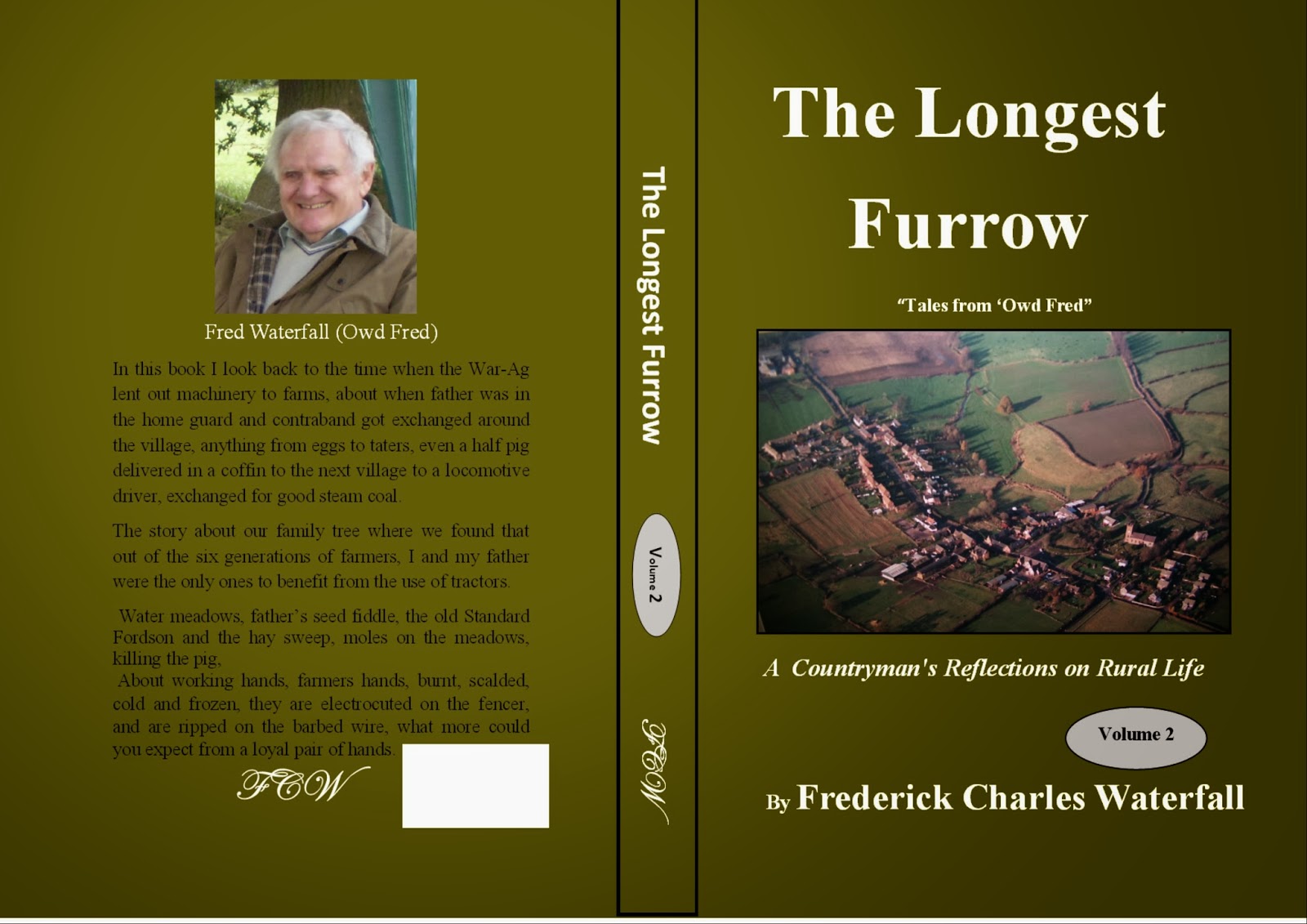
For those who would like to read some of these blogs from a book, this is what I have had published, its called "The Longest Furrow" by Owd Fred. 

You can find them on----    Amazon Books The longest Furrow  ---   in Google or any search engine, there are four Volumes now on sale with a fifth in the pipeline.

Locally I find that its the older generation that are interested, the ones who do not have a computer, and cannot read what I've written, at the moment they are being bought as a Christmas presents for grandpa or grandma. 

It gives an incite how one individual  (me) has lived all my life on the farm, I am second of four, father was eldest of four, grandfather was one of eight, G. grandfather was youngest of seven, G.G. grandfather was youngest of eight, and my G.G.G. grandfather was born in 1753. 
Out of the six generations of farmers, I and my father were the only ones to benefit from the use of tractors.


These books are being sold and money raised goes to a head injuries charity


 Headways North Staffs.


The front picture on Volume 2 on the right is of our village.
Top left in the picture is Beeches Farm where I was brought up, bottom right is St Chads Church and just above left of its tower is Church Farm where I started farming and farmed for 25 years.
 Bottom left in the picture with the white roofed farm building is Yews Farm where I have farmed (30 years) up to present day.


One thing I have never blogged about , and I do not intend to here, and that is the fact that we lost our only son who got fatally injured on our own farm yard at the age of twenty one, and it is the Headways charity
who do a wonderful job of helping those who have gone through such trauma  and survived. We do our best to support them as they are all volunteers who run the Charity and are always very grateful of donations collected.

I am sure you will get as much pleasure reading this as I did out of writing and compiling the books.

Thank you in anticipation.

Fred Waterfall  (Owd Fred)


Monday, 23 September 2013

The Blacksmith 158

Village Craftsmen - The Blacksmith

Up until the 1950's almost every village  had all the regular craftsmen that covered all aspects of village life, from the nurse come midwife, to the wheelwright who not only laid out the deceased made the coffin and dug the grave, and pulled the four wheel hand pulled hearse, then made or repaired farm carts, made ladders, wheelbarrows,gates, and every thing in between. A brick layer on the estate maintenance  a cobler who mended and made boots and shoes and made and repaired horse harness  a shop keeper, a school , the vicar and of coarse the blacksmith, not forgetting the pub.  There was nine farms that surrounded the village five of which were in the centre, all the farms milked cows, and around pm in the afternoon herds of cows walking on the village roads in all directions, to their respective farms from out lying day pastures. Two herds passed through the this ford every day 


 This is an old picture of St Chads church looking from the north side, to the east end (left) of the church you can see the many chimneys of the big old vicarage which is now demolished

                                    The Blacksmiths Shop around the 1950`s
   Mr Giles travelled from Stafford to the village for two and sometimes three days a week; he also had a forge in East gate Street Stafford. With the number of horses rapidly declining it did not justify a full time blacksmith in the village. His main job was shoeing, welding repairing and fabricating gates and fences. Outside the blacksmiths shop was a heavy cast iron round disc, about 5ft across; to clamp wooden wheels down to while it was being hooped. To the extreme right ,at the chimney end was a tall narrow furnace ,the inside dimensions being only 18inches wide, but 6ft high and six foot long to heat up the wheel hoops to hammer them onto the wooden wheels.
   This furnace had a crude steel door to make the draught draw under the gap at the bottom, and through the fire grate and up through the depth of coke, to provide the heat. The fumes joined the chimney that is still there to this day. This furnace had quite thick walls and an arch at the top, then a depth or sand on top to help keep the heat in a tiled roof to keep the weather out.
  The original doors still cover the windows, but then they were just opening, never had been glazed. To the left of the double doors was a large pile of sweepings out of the shoeing bay, comprising of hoof trimmings and filings, dried on mud carried in the horse's hooves, and whatever the horses cared to leave behind. Through the double doors was the shoeing bay where the horses were tied up. Then through a door immediately on the right, the first thing you saw in the middle was the anvil, this stood on a large piece of  elm log to bring the top of the anvil to about two and a half foot high, handy hammering height. To the left was a pile of worn out horse shoes, some with nails still in. On the right fastened to a bench was a metal bending tool to form the hoops for cart wheels, this could be adjusted to how tight the bend needed to be. The strip of flat iron would be heated then the end fed over the first roller under the second and over the third. A big cranking handle turned the rollers the middle roller was screwed down to put pressure to curve the metal. The next along the bench was a large blacksmiths vice; this had a heavy bracket along the front edge of the bench, and a leg down into the floor. A long shiny bar with a knob at each end to tighten it with, and well worn jaws that had gripped and been hammered for what seemed to be generations. Also on this bench in front of the second window was a pillar drill , this had a large flywheel that turned horizontally above your head and a crank handle to the side driving it, underneath was a huge chuck and a small vice to hold the metal while being drilled.
   At the far end of the shop is the forge, this was made of bricks. At the front was an arch about eighteen inches high, by three feet wide with all sorts of scrap metal (useful off cut is the term I'm looking for) stuffed under for safe keeping. But the arch has a more practical reason for being there; it's for the blacksmith to put the toes of his boots under so he can stand closer to the forge without bending forward. The top edge of the forge the bricks had a rounded edge then nine inches in it was filled up with fine coke. The hearth was open on two sides, and bricked round on the other two with metal lining to protect it from the heat .Over the top was a metal hood with inches of dust on it leading into a brick chimney. At the back of the forge were the bellows, at one time, before I can remember he used the old bellows worked by foot pedal, made out of leather? These stayed there for quite a number of years, but got hidden by the "useful off cuts" but now the blowing was done by electric fan. All round the front and sides of the forge, except where he stood, were brackets holding all the tongs and tools of the trade. On the wall forming the left hand side of the hearth was his office; this took the form of a couple of nails with notes thrust onto them. One held the draughtsman's drawings of some fabrication job he had to do (drawn freehand on a torn off piece of cardboard full of thumb prints) one of many that had been put on before it. The other nail held an assortment of his wardrobe leather aprons jerkins and leggings that were in varying stages of dilapidation, the oldest at the back, right up to his older cap used when shoeing horses on the top. He had to reach just under this pile to operate the switch for the new electric fan.
   First job when he arrived in a morning would be to light the forge, a few sticks that had been kept in a dry and warm place over night would be placed in a hollow in the centre of the hearth on a couple of sheets of crumpled newspaper. This was lit and the fan put on low, as the flames got enthusiastic some coke was gradually pulled over the burning sticks, and within a couple of minutes the fire was hot enough to boil the kettle. The fan was turned off and the fire would remain dormant most of the day, it being ready at a moments notice when switched on again. Along side the forge was a  rusty dousing tank three quarters full of equally rusty water, where metal that needed cooling quickly was dunked in with a tremendous fizzling in clouds of steam, on the end of his tongs.
At the back of his work shop was a rack that held new metal of all dimensions, some for horse shoes some for cart wheel hoops, some for making gate hinges   and all the ironwork needed when the wheelwright was making a new cart or wagon plus everything in between. This had to be reached by climbing over, jobs waiting to be done, things taken in as patterns and all the useful off cuts that might come in handy (should I say scrap metal). The only clear floor area was from the door to the forge and round the forge, then round the anvil. 
   Every so often they would fire up the furnace at the end of the blacksmith's shop for hooping wheels that Mr Clark the wheelwright had made or repaired. The hoops would be lifted out red hot and burned onto the wooden wheel that was clamped firmly on a huge cast iron disc that was permanently on the frontage of his shop. When hammered down into place firmly, water would be poured on to cool the iron hoop and shrink it tight onto the wooden wheel, these would then be rolled across the road and leaned against the wooden fence opposite, as many as twenty five of all sizes and weights ready to be repainted and refitted to there respective vehicles. On certain days of the week he would concentrate on shoeing horses mainly shires some cobs or float horses and a few hunters.
  When our two remaining shires wanted shoeing we would be put up on top of them and set off to school, Mr Giles would lift us down to continue to school, then on the way home for dinner we would be pushed back on top to take them home again. Some times he would let us switch his forge fan on to heat a horse shoe, the shoe on the end of his tongs he would bury it in the centre of the burning coke for about a minuet, and it would come out more than red hot but going white hot with little sparks jumping off it. This would hold the heat while he burned it onto the trimmed hoof of the shire, this made the shoe touch the hoof all the way round and bed it in amid clouds of smoke. The shoe was then cooled before nailing it onto the horses hoof, the new set of shoes would last 6 to 8 weeks depending on the roadwork do. Old "Flower" one of our shires, had a habit of twisting her one back foot every time she put her foot down and would ware this one shoe out in a month, so an extra visit was necessary for that one foot every now and then.
I can still hear the ringing of the anvil as the blacksmith pumled the soft hot metal into the desired shape, after every blow to the metal he was working with there would be at least two smaller bounces of the hammer on the anvil creating a very sharp ringing, then two or three blows to the hot metal quite a dull sound. As the metal cooled to a dull red it would harden again and have to be reheated then the finer touches would be made turning it over and around until it reached the shape he wanted. It was a very hot job, sleeves rolled up and a heavy leather apron on, his cap turned slightly more than when he was cool and tipped back a little. Everything he used was shiny made so with the palm of his hardened hands that held the skill of many years of experience

The blacksmiths shop closed around 1975 as did the wheelwrights, horses had reached there lowest numbers, with no shires at all in this district, but riding horses and ponies are on the steady increase and mobile farrier are taking over. The demand for wooden carts and wagons gradually came to an end as tractors with hydraulic tipping became more popular.


This was the blacksmiths shop  in 1945 when we were going to School. The tall narrow door on the right, was a furnace in which the iron hoops were heated red hot then hammered over the wooden wheel, which was clamped tight on the cast iron circle, permanently situated outside his shop.

             I Remember Blacksmiths Shop

This was the blacksmiths shop in  1945 when we moved to the village and started school


I remember blacksmiths shop, all dingy dark and dusty,
Great big pile of horse shoes outside, all a going rusty,
Tom Giles was smithies name, all jolly strong and hot,
With shoeing father's horses, he did the blooming lot.


When setting off to school one morn, the horses we would take,
To blacksmiths shop for shoeing, would make us very late,
On going home for dinner, these horses we would ride,
Pitched up high on Flower, the others led with pride.


Welding cutting bending shaping, everything was there,
To make it new, or fettle up, to make a good repair,
His stock of metal had a rack, but most of it had missed,
It lay about in piles around his forge, which was in its midst.


All day you'd hear the hammer, a ringing out aloud,
Hitting out the red hot metal, made him very proud,
The different shapes and sizes, needed for a gate,
Lay around the workshop floor, no need for him a mate.


Alone he worked all day until; we kids came out of school,
Then he would be invaded, his metal then would cool,
On his forge he put his kettle, there to make some tea,
We kids tried out his drilling tool, great flywheel turned by me.


With tongs we tried to heat the metal, in the furnace hot,
To make and shape we would try, to bend on anvil, but,
Not hot enough to work it, so pumping the bellows up,
It made the spark fly every where, our school cloths covered us.


The water in the blacksmiths shop, was warm to wash our hand,
With dowsing all the things he'd made, red hot metal into bands,
With cloths soiled and singed, and not a hole in site,
Mother knew where we had been, said it's late it's nearly night.

Owd Fred


Education is not the filling of a pail, but the lighting of the fire.Quotation by W B Yeats

Wednesday, 11 September 2013

Farming on a peat bog 157

Farming on a peat bog (only part of the farm)

Almost a quarter of our farm is on a peat bog, at one time each of the farms in the village had a proportion of this peat ground, splitting and fragmenting the farms.
In the last forty years as farms became vacant with retirements the estate amalgamated the farms into bigger units and got them into ring fence units. My farm being to the east side of the estate nearly all this peat ground fell into my circle on the map.
When I first started farming, and fresh from farm college, keen to try out new ideas, I had a small area of peat and some river side land as well, both areas prone to flooding once the river bloke its banks.
 The peat grassland was full of buttercups and the soft rush, and when neglected the soft rushes became what we called ‘sniggle bogs' the centre of which rose up and made it impossible top cut with the old finger bar mowers.
So being keen I contacted my local MAFF  (Ministry of Agriculture fisheries and Food) adviser. He was and old man who had had plenty of experience and seen these type of meadows before.
Being peat it was very acidic and no amount of lime would bring the PH levels up to that required by modern seed mixtures he advised. Best way was to improve the indigenous species of grass that was already growing down there.
First job was to rake or harrow the centre out of these ‘sniggle bogs' and if that did not work it was advised that I take some bags of Sulphate of Ammonia fertilizer and a bucket onto the meadows and place a handful of the fertilizer into the middle of each bog of rushes, the aim was to burn the centre out of the bog and the nitrogen fertilizer would benefit and encourage the surrounding grass.
After a couple of years these risen bogs had disappeared and the remaining rushes could be cut twice or three times a year with the finger bar mower. In later years, and as I took over more of the meadows the finger bar mowers had been supper seeded by the drum or disc mowers, and these were capable of cutting directly under and sniggle bogs cutting out the hand work involved in burning the centres out with fertilizer.
Back to the early days, once the meadows were mow-able, I started to leave a good proportion to cut for hay, it was before silage was invented in our area, and we managed to get the baler on to the meadows to bale the crop.
Confidence building and wishing to increase the yield of hay a complete fertilizer was applied and a tremendous response was seen from the old grasses that grew on the meadows, it was difficult to mow with the finger bar mower as there was a certain amount of rotting vegetation at the bottom of the sward so dense that it lacked sunlight. It was okay for the first one or two summers when the weather was with us, then we hit a bad year weather wise
It was mowed as usual and after two days was turned with an old ‘dickey swath turner' this flipped up just over half of the heavy side of the swath, a second turning the next day brought the rest of the swath to the top, it was at this point that  the weather bloke and we had a very heavy down pour. A deluge that went on for most of the night, bringing the brook that run through the meadows to over flow, of course at mowing time of year, the brook and the river lower down were also weeded up which impeded the flow.
So it was the following day we watched with dismay, the water rose in between the heavy swaths, and later that day the swaths were actually floating and drifting to one side of the meadows. As the water receded so the swaths settled nice and neatly over each other each four foot swath now being four inches apart with overlapping. The whole crop was lost and that part of the meadow ruined for the next two years where the swaths lay and rotted down.
On reflecting back without the fertilizer, and with lighter crop that hay could have been baled a day earlier and the bales carted. That was imprinted on my mind for the rest of my farming days, however on the odd occasion we have had bales stranded and standing in flood water when rucked into piles of eight, only the bottom two were ruined and the other not up to much by the time they were carted. But that is the risk taken on these meadows.
Up to these modern times, the meadows are the same, we take the crop it produces usually towards August being the best time to cut, they are cut with a fifteen foot disc mower conditioner, wilted one day rowed up and baled in the following day or two days depending on the forecast, being big round bales these are loaded and moved without much physical effort on my part, that suit me fine, and stacked at home outside.

These ditches are bottomless, and the meadows mown leaving two metres uncut by the water course. 

  This type peat meadows now are getting rare and Natural England, the modern equivalent of MAFF have asked if they could monitor these meadows of ours and sent out advisers to study them. Some groups have been round from Nottingham University and now they are monitored and controlled by the Stewardship Schemes that I participate in.

Some of the principle rules that I have now got to abide by to maintain these meadows and receive a subsidy for doing so is,
 
1 Not to go on the meadows for any reason before 15th July.
 This is so we do not rut and poach the ground; this is what I have already done over the last fifty years
 
2 Do not apply fertilizer or lime or farm yard manure.
Its impossible to get on the ground to spread FYM and as from experience no fertilizer or lime has ever been spread by me over the last fifty years. (Other than the few years explained above)

3 Graze the aftermath growth of grass and remove stock by 1st November every year.This is what we have done on the meadows over the last fifty years. 

4 The Ditches and dykes only to be cleaned of every third year in rotation.
Well that job is taken out of my hands, I have never done that job, it is undertaken by the River Board who clean out all the main rivers and water courses below a certain contour line. Never done that job over fifty years.
 
5       Leave two metres un-mown along side all water courses.
This is new to me, with the modern disc mowers you can only cut to the top of the bank or edge of the ditch, with the old finger bar mower you could hang the cutter bar down almost to the waters edge. The longest swath with the most grass is always the outside one. We loose out on that last swath of grass. So this rule is already catered for with the use of the disc mowers. 


Year 2008 was interesting in that I was approached by the Environment Agency, Natural England, they wanted me to go on a scheme Farming Flood plains for the future project.
They are looking at raising the water levels of our moor (peat) during the winter month. This they did by inserting some controllable dams in key sections of the ditches, and held the water at field level through to May when a sluice was opened in each dam to return the water level back to what was it natural levels. Below and above each dam was a censor, to measure the water levels by computer, and again censors out I the middle of the fields to register the water table again they connected to a computer to read the levels every few weeks.
All this work and altering the water table levels did not affect the crop of grass that we harvested at the end of July and August.
Conclusion, not enough infield standing water to benefit wading and wet land birds, so the dams were not closed in the winter of 2010, but the levels are still being monitored.
So it looks like I should be telling them how to maintain the meadows, and do like I have done for the last fifty years, but some folk just will not be told.
   
Another project was under taken on the moors when I was asked if the Wildlife trust could do a botanical survey of all the interesting indigenous species of plant growing on the peat. Apparently there are not many of these old untouched meadows left in the country, and this is what they found almost 40 different species.
  Habitat: Neutral grassland: unimproved  29/05/2008
Recorder(s): -----(I won't name them here)-
flowering plant
Alopecurus geniculatus  Marsh Foxtail locally  frequent     
Alopecurus pratensis      Meadow Foxtail           abundant
Anthoxanthum odoratum Sweet Vernal              Grass abundant
Caltha palustris               Marsh-marigold          rare
Cardamine pratensis       Cuckooflower             frequent
Carex acutiformis           Lesser Pond-sedge      locally frequent
Carex disticha                Brown Sedge               frequent
Carex hirta                      Hairy Sedge                frequent
Carex panicea                 Carnation Sedge          rare
Cerastium fontanum        Common Mouse-Ear occasional
Cirsium palustre              Marsh Thistle              rare
Deschampsia cespitosa  Tufted Hair-Grass        occasional
Eleocharis palustris        Common Spike-rush locally abundant
Festuca rubra                  Red Fescue                 occasional
Filipendula ulmaria        Meadowsweet locally frequent
Galium palustre              Marsh-bedstraw           frequent
Glyceria fluitans             Floating Sweet-grass   abundant
Holcus lanatus                Yorkshire-fog               frequent
Juncus articulatus           Jointed Rush                 occasional
Juncus conglomeratus    Compact Rush               frequent
Juncus effusus                 Soft-rush                      occasional
Lathyrus pratensis          Meadow Vetchling          rare
Leontodon autumnalis    Autumnal Hawkbit           rare
Lychnis flos-cuculi           Ragged-Robin                   rare
Persicaria maculosa        Redshank locally            frequent
Plantago lanceolata           Ribwort Plantain            frequent
Poa pratensis                 Smooth Meadow-Grass    occasional
Ranunculus acris           Meadow Buttercup            frequent
Ranunculus bulbosus        Bulbous Buttercup            occasional
Ranunculus flammula        Lesser Spearwort locally    frequent
Ranunculus repens             Creeping Buttercup            frequent
Rumex acetosa                   Common Sorrel                 occasional
Senecio aquaticus             Marsh Ragwort                         rare
Stellaria alsine                 Bog Stitchwort                          rare
Taraxacum officinale agg.  Taraxacum officinale agg.     rare
Trifolium pratense            Red Clover                         occasional
Veronica serpyllifolia      Thyme-leaved Speedwell              rare
Vicia hirsute                        Hairy Tare                                rare
    
We were asked if one of our meadows could act as a donor meadow, to provide seeds to another meadow 20miles away. 
 So on a pre-booked day we mowed (mower without the conditioner we need the seeds to stay on the plants) and baled the grass/crop loaded it on their transport and by mid afternoon it was being spread on the receiving  meadow, for the seeds of all the above plants to establish on a new meadow. Not had any feed back on the results but I imagine it will take a long while before it can be said to be successful. 

Old Maps.


Its nice to look at very old maps, all faded and dog eared,
See what has change over the years, and what has disappeared,
Years ago they measured the land, all in furlong and chain 
The length of a furlong a chain wide and an acre to attain,
Most roads and lanes are still the same, so are most the fields,
Village houses have increased built in corners quite concealed.


Countryman  (Owd Fred)


Wednesday, 4 September 2013

Vicon Acrobat spider wheel 156

Vicon Acrobat spider wheel 50 Years ago (May 1962)

We took delivery of a brand new Vicon Acrobat spider wheel hay turner come rowing up tool fifty years ago this month.
It was an amazing machine at the time with no driving parts or gears, just turned by dragging the four wheels along the ground at an angle and it raked grass across just to turn it or to row up ready for baling.


It suited the small tractors of the time like the Ferguson T20 and the International B250 that we had, Took some getting used to working it as any twist if the steering wheel would throw the rear end of the mounted machine in the opposite direction, missing the particular swath that your working on, so accurate and constant attention to ya driving was essential to make a good job.
It made a good job in light crops but rowing up hay made from long tall grass it had a tenancy to roll it into a long rope of hay the length of the field. The pickup balers of the time, we had an International B45 baler, was driven by the B250 tractor, had only the single clutch, which meant the baler started turning as the tractor started moving forwards and stopped whey a wheels stopped. When in first gear and this rope of hay started going in too heavy for the baler to take, it would drag the hay form forward of the tractor stalling the tractor and blocking the baler intake.
This Vicon Acrobat turner survive for almost 50 years on this farm although it had been supper seeded by other mounted twin  rotary tedder come rowing up machines that were power driven, we still turn back to then vicon for work on light crops
Many of these Acrobats could be seen on stock farms used for blocking a gap in a hedge to keep cattle from escaping, ours had that job over some winters when not in use, but eventually the frame started to crack up with all the whipping about that it got working through dips and hollows on the peat meadows.
I still have the machine now, but is looking dangerously close to the scrap ruck.

    
The Scrap Ruck

I got a pile of scrap iron, and it builds up real fast,
And another round the corner, where I dropped it last,
I save it just in case, nothings ever chucked away,
Piles of it every where, It might come in one day.

Broken bits of tractor, and its off cut bits of steel,
Some is thick and some is thin, and some a bit of wheel,
Angle iron in six foot lengths, some point was a bed,
Other bits chucked into the rucks, some still painted red.

Nettles growing through it, and it makes a nesting site,
For rats and mice and vermin, who are only out at night,
Disturbed they run like mad, get away from you or me,
And where do they head for, their scrap ruck home with glee.

I'm looking for a bit of metal, the size ta mend a gate,
Seen some in the scrap ruck, but I can't locate,
Remember when I chucked it, don't know which pile it's in,
Turn each pile over and see, praps neath that pile of tin.

It's rusting in the winter, when the snow and rain soaks in,
It's rusty and it's flaking, and its no use for welding,
Don't know why I saved it, cus the price of scraps sky high,
Have to have a clear out, home for rats and mice deny.  

Owd Fred

Sunday, 1 September 2013

The Se-----ford Staffordshire Hoard 155

The Se-----ford Staffordshire Hoard 


Most everyone in the world must have heard about the Staffordshire hoard, all that buried gold found in a ploughed field a few years ago not that many miles from me.

Well this is my contribution to finding treasure on the farm, and its took me fifty five years to find this.

1772 Silver George 3rd half penny piece


Its not every day that you have a "find" even though it be modest, a friend of mine was walking the footpaths along our fields a few days ago, and came across a rabbit hole with fresh soil dug out of it. On top of this soil was a coin, he picked it up, took it home and cleaned it, and found the date on it to be 1772.
He told me about it and gave it to me to investigate its value and coinage, It turns out that it is a Silver half Penny George 3rd.


You can only imagine back years ago, a farm worker layering the wood side hedge, with his jacket slung over the completed hedge, dropping a coin out of the pocket, a coin that would be the biggest part of his week’s wage.
How the coin lay in that hedge bottom for over two hundred years, leaves rotted covering it, soil brought up by earth worms allowed it to gradually sink beneath the ground, eventually being dug out by a rabbit only an hour or so before being spotted again by human eye after all those years.

It’s often said that stiles, foot paths and gateways are the place to use the metal detectors, also old cottage gardens and cottages pulled down years ago. I think we have almost come to an end of finding old work horse shoes, they often end up round the point of the plough sooner or later.
 
We did find a billhook, that’s a chopper used when chopping sticks or even laying a hedge, the wooden handle had long since rotted away leaving a six inch long spike which ran through the handle, and by some misfortune the tractor front tyre found it.
Without me knowing it was gripped in the tread of the tyre and came up under the plastic/rubber mud guard/fender blade first and sliced two inches off the mudguard all round, it was the bit that folds over the edge that helps to give it strength.

The tractor at the time, that day was a new demonstrator tractor from the local dealer, a Deutz four wheel drive 100 plus horse power. It was trimmed off so neatly that the dealer never noticed it and it eventually sold on to a farmer, who again did not twig what had happened.
The tyre went down rapidly and a repair man came and patched the tyre and blew it up, there again you could not see where it had been spiked, I have no doubt that eventually the cords around that area spiked would give way after a few years of hard work, and a new tyre would have to be fitted.
The billhook was duly dispatched to the scrap ruck and safely stored until it was weighed in to a scrap yard.    


Time is the coin of life. It is the only coin you have, and only you can determine how it will be spent. Be careful lest you let other people spend it for you.Carl Sandburg  (1878 - 1967)

Wednesday, 28 August 2013

How do you define a working farmer’s car? 154

How do you define a working farmer’s car?

Pulled out all parcels and shopping and stood back, while the old Austin Montego finally cremated itself in the middle of the road.

The old Austin Montego Estate Car, it was a farmers car, or life before we had a Landrover 1970’s / 80’s ( The demise of the Land Rover blog  http://bit.ly/k0C2mG )

How do you define a working farmer’s car, a car that can pull almost anything, a car that you can chuck anything that will fit in it, a car with a drawbar that is good and shiny not the one with the plastic horses head knob cover.
A car that when the dirt gets thick enough it will peel off in the sun, a car that is always at the ready for the umpteen short journeys be it lanes or fields, and almost invariably low in fuel, no time to go into town to fill it up.
A car that when a big bullock walks up the tailboard it lifts the ass end of the car off the ground, and when he walks to the front of said trailer it almost bury the drawbar in to the mud, (good suspension).   


A few years ago we had an Austin Montego car, a five door estate model, bought it second hand never having seen mud or cow muck, it was in mint condition. It did good service for us but as always it would be almost its last home.
The first thing was to have a drawbar fitted so it could pull a caravan and the stock trailer; the caravan was a nice stable steady pull although only just up to the job.

The stock trailer was another kettle of fish, it all depended on how many beasts were loaded into it, on odd occasions it got positively over loaded, heaving up and down on the drawbar when loading and unloading, and then on the road it weaved as the speed built up to 30MPH.
As it happened I bought the standard drawbar fitment for that make of car, the arm reaching under the car just bolted with four bolts to the tinwork under the spare wheel in the boot.
There was a lip that reached up to carry the weight of the drawbar going up behind the plastic bumper again bolted into tinwork.

As you can imagine after a couple of years work with intermittent use to pull the stock trailer these bolts holes cracked in star fashion round the holes and eventually pulled through to tin bodywork. To remedy this we welded an angle iron to the carrying bracket so as to spread the load all across the back end of the car, if it pulled out again it would take the whole of the back end off.
I got to know when things were getting dangerous when you could hear a continuous creaking coming from the spare wheel housing.
After the beefing up with the angle iron, the long arm that reached under the spare wheel with its four small bolts started to creak and these were washered up with large round washers, but still it creaked under load.

The car then started to over heat intermittently as though the rad was blocked, they did not have a fan belt, but a thermostat connected to an electric fan, and it turned out that this thermostat was faulty , not switching the fan on when it called for cooling.
Everything worked normally when travelling along briskly, the wind blowing through the radiator did its job well, but this one bank holiday weekend we went out into the Derbyshire hills and got stuck in a great line of vehicles mostly stationary, on the run up to a road junction.
As we kept moving up so the car got hotter, we had the heater on in the car (on a hot day) to try to help cooling the engine, then to our relief we got past the junction and onto open road again, the snag then was we had a long two or three mile climb, working the engine hard, and although the wind was blowing through the rad it was not enough to cool the already hot engine.
Then on a long down hill where we cracked on with speed and not too much work for the engine when a cloud of steam burst from under the bonnet and we coasted to a halt in the mouth of a quarry, looked underneath to find a pool of oily water, the car had expired in a cloud of steam.

After getting a lift home we collected the car a few days later, towing it home on the end of a chain.
As it happened we did get the engine going again and sold it on to a family as a “second” farm car, another rough lane for it to negotiate and a bigger family of kids.
Some months later we heard the they were travelling home from Christmas shopping, loaded up with kids and parcels, going along a remote lane when the engine burst into flames,
The mother pulled out all the kids and parcels and shopping and stood back, while the old Austin Montego finally cremated itself in the middle of the road.

It had not done a big mileage with us or the folks after us, but it had worked hard, pulling the stock trailer, and after us we found out he was pulling a double deck sheep trailer, so it had earned its keep over those few years. This is why we always say “It’s come to its last home when it comes to us”     


If the automobile had followed the same development cycle as the computer, a Rolls-Royce would
today cost a hundred dollars, get a million miles per gallon, and explode once a year, killing everyone inside."


Robert X Cringely, Info world

Friday, 5 July 2013

Ash Trees have Shallow Roots 153

How we found out that Ash Trees have Shallow Roots

In all my seventy three years, it was only during my first nine years that I had anything to do with our farms three shire horse. The most regular job was to lead them to the blacksmith's shop with my brothers on the way to school. They would stay there from nine in the morning until lunch time at twelve o'clock when we were pitched up on top of them and they would take us home for our mid day meal.
In 1942 father bought a Standard Fordson tractor along with a two furrow plough and a tractor cultivator and a set of disc harrows, this took a lot of hard work off the horses, as by now they were getting older. He still had the old ploughs and single row cultivators, the corn (wheat and oats) drill, though by now he had converted the pole of the drill by shortening it and put a clevis hitch on the end so it would be pulled by the Fordson tractor. The binder also had a pole that was rigged up to take three Shire horses abreast, again this was shortened and had a tractor hitch fitted, that was another long and mauling job that was taken off the ageing shires.
By the time I was fourteen we had two tractors, this second one was a David Brown Cropmaster with hydraulic linkage and a hydraulic linkage plough to match. A problem started to crop up where by the headland of each ploughed field was not being ploughed close enough to the hedge row like father always did when he plough with horses.
He always claimed that there was more soil in the last furrow round the outside of the field than any other furrow in the field, and it was always said in jest years ago, that when any farmer was expecting an addition to the family "you will have to plough another furrow closer to the hedge".
Well this was not the case on this occasion, father asked me and my elder brother to take the Cropmaster tractor and a single furrow horse plough and plough an extra furrow closer to the hedge all round the ploughed fields. Myself being the younger and smaller one drove the tractor, and brother who was bigger and stronger controlled the plough, there was a length of chain connecting the two and hitched to one side of the tractor.
Father had set us up and we were progressing well, he had left us to get on with the job at hand, we had a bit of shuffling at the corners and in places we managed to go round a second time, until, we came to an Ash tree.  Ash trees are well known, (but not to us) for having strong shallow roots that spread and grow close to the surface, and do so when the field had been in grass for three years in the rotation, then suddenly there is a problem.
With the horses, they would feel the root and promptly stop, with no damage to the plough or them, but with the tractor, that had no feelings, and a lot more power, it grunted on and snatched the plough, which was well hooked under the root, and it flipped the plough handles skywards along with my brother. Brother was okay, if a little bruised, but the plough was destroyed and lay under that tree for years, an ever lasting reminder that Ash Trees always have shallow roots.


This is my father in 1940 mowing grass with his shire horses Flower and Dolly, he lost two fingers as a lad clearing the blade of a mower the same as this. The horses are in Chain harness. For shaft harness they had a heavy saddle pad and a breaching round their rumps

I Remember Fathers Fingers
A tale he told us while working for his uncle Dan, he must have been around thirteen years old

Father lost two fingers, while mowing hay one day,
He was helping uncle Dan on the meadows, not at all at play,
Only thirteen started working, horses in the shaft,
The mower blocked with grass, clearing it by hand (how daft)

He lifted blade and went round back, while it was still in gear,
One horse did stamp his foot at flies, and gave the blade two shithers,
This was just enough no doubt, cut two fingers in one go,
He never said how he stopped, the blood, there must have been a flow,

The little finger it was off, above the lower joint,
The next was off above second, clean cut to a point,
Hospital took one off at knuckle, and stitch the flap of skin,
Tuther  left half a stub, of finger what a sin.

No safety men to bother them, it was get him back to work,
They healed so slow, it was a blow, but not a time to shirk,
A motor bike he bought one day, to get about much quicker,
It had a belt to drive, hand clutch, and blow up tyre,

Mother he did find one day, while he was out on bike,
He gave a lift and she did find, how cold the bike could be,
Knit pair of gloves did she, to fit his fingers short,
Then regularly did see her out ,and then began to court.

Round the table Sunday breakfast, father told us tales,
Of how he helped his uncle Dan, less fingers and no bales,
We had to always asked him, to tell us that again,
Of how he lost his fingers, and all about the pain.

Countryman (Owd Fred)

Friday, 28 June 2013

A Grip like Iron 152

A Grip like Iron

I don't know how mother came to have such a strong grip, (she could actual crack a walnut in her hand)  if she caught a hold of you for some reason, there was no hope of getting away, perhaps it was the hand milking in her younger days that gave her that grip, I remember some old cows were very hard to milk, it seems to have been bred out of them nowadays along with the bad feet and curled up toes and pendulous udders.


Mother had a Grip like Iron

When mother was young she had help, around the family farm,
Milking cows by hand them days, strengthened sinews in her arms,
Her hand were still ladies hands, no bulky muscle show,
Belied the strength built into them, beyond you'd ever know,

Mother had a grip like iron, nothing failed her grip,
Screw lids on jars and bottles, give it me she'd quip,
The grip she had to skin a rabbit, or ring an old hen's neck,
Crush a grape; she'd crush a walnut, power she'd got by heck.

Round by the coal ruck was her hammer, there to break the coal,
Coal it came in big lumps, some from steam loco it was bowled,
For coal alone the big lump hammer, it was there reduce.
Best steam coal was hard and bright, cracked it down for use,

When we were young she'd lace our boots, bow she'd pull real tight,
They never came undone all day, right into the night,
Sewing did with button thread, no tear came open again,
And buttons only came off once, thread she used times ten.

With age her hands were not so nimble, feel it gradually went,
Knitting that she'd done all her life, on wool she no more spent,
Her skin and nails were without blemish, soft and pink they were,
But on grip she never lost her strength; she was the best mum ever.

Owd Fred

When she sat down in the evening, mother would pick up her knitting, she could knit without looking and when we had our first television she could watch and knit at the same time. Jumpers hats gloves scarves socks( with socks she knit button thread along side the wool while knitting round the heels) she always had a good stock of wool. There seemed to be two stock colours, grey and fawn, other colours were bought for a specific jumper or sweater. When the need arose she would be darning socks, nowadays they get thrown and a new pair bought.
She liked to experiment with new patterns which she gleaned from her magazine, but mostly she only did the patterns up the front where it would be seen, then she could "bomb" on with the back and would produce a jumper in a week.


Mothers Weekly Magazine

Mother had weekly magazine, knitting patterns every week,
These she used to knit up the fronts, of our jumpers so to speak,
Some were cable some were ribbed, some were chequered squares,
Some were bobbles in a lump, couldn't buy anything that compares.

The wool she bought was in skeins, a dozen at a time,
This she got us to hold while she wound into balls like twine,
We held our hands out at full stretch, while she wound full tilt,
Arms would ache on the second one, then our arms would wilt.

Brother next in line was asked, turns we had to take,
Wool was grey, or fawn, or blue, for what she'd got to make,
Socks she knit one every night, jumpers took over a week,
Stitch the front and back together, sleeves to the arm holes tweak.

Started with the welt, the grippe bit round the waist,
Tested it on the one who it's for, half way round our hips she placed,
On up to the armpits, try it for length again,
Then the neck onto the shoulder, it was a blooming pain.

Next the socks they're mostly grey, started top welt round,
These were pulled up to our knee, and turned the top bit down,
Knit on down to the heel, measured it on our legs,
Three needles used on this job, pulled them on like stuck out pegs.

Heels we always wore out first, so in with the wool she knit,
Strong button thread along side the wool, in pattern this wasn't writ,
So when they did get bare and thin, she darned them time agen,
Then they were called our working socks, for us working men.

Sometimes when jumpers, got wore out up the front,
She would unpick the seams, and rewind a whole segment,
Then would knit again, into little gloves or woolly hat,
In winter balaclava, or scarves on many things she'd tat.

When we were young she'd knit and knit, no woollies bought at all,
As we left home she knit again, next generation when they were small,
Knit up to her seventies, when finger would not flex no more,
Big blow it was, she knit by feel, for old age yet, there is no cure.

Owd Fred

Don't rule out working with your hands. It does not preclude using your head.Andy Rooney (1919 --)

Saturday, 22 June 2013

The Old Kitchen Floor 151

The Old Kitchen Floor


I remember when we were kids, kitchen floor it sloped,
Sat down at meal times, mother to top end coped.


The old kitchen floors were always laid to enable them to be washed down with a bucket of water, the water then run through a hole in the wall and into an outside grid.
In the 1940's I remember a kitchen on a smallholding, (not our kitchen) it adjoined the cowshed, just open the door on one side of the kitchen, and there were the cows all tied by the neck by a chain to their stalls, all ten of them.
The only snag was that the cowshed was top side of the kitchen and the drain from the shed ran through the kitchen under the table and out the other side in an open gully. Every time a cow passed (pee'd) water it would run swiftly almost under ya feet when sitting at the table, to anyone outside cow keeping would be horrified, but the smell of cow urine is just a normal part of a cowman's everyday smells and has a tendency, I am told, to help to clear your sinuses'.
The dung was wheeled out of the door that led to the fields, the way the cows came in and out, but the liquids took the shortest route and followed the slope of the cowshed and kitchen floors.
 It would not be aloud to happen these days, on health and safety grounds, but it did back then, and clean milk was sold. The kitchen was clean and the gully kept rinsed and clean.
Those cows were often seen back then, being grazed up the wide road side verges tended by the elderly owner who stayed with them. That house and small cowshed have long since been the victims of barn conversion, modernization, what ever you want to call it, but I will always remember it as the house where the cowshed and house were all as one.
Our kitchen at home when we were kids, had blue brick floor and a slope of four inches from top end to the lower corner, the drain hole had been stopped up to prevent rats and mice coming in, and it was mopped rather than sloshed down every day, I remember when mother had her first electric cooker, it had to have a patch of floor levelled up especially for it, other wise the pots and pans on the cooker would have had too much of a tilt East to west.


I remember The Kitchen Floor it sloped.


I remember when we were kids, kitchen floor it sloped,
Sat down at meal times, mother to top end coped,
Kitchen table vinyl cloth, also it did tilt,
Father down one side, safe from anything that spilt.


Always there is one, who's clumsy as a kid,
Put him at the lower end, own mess he is amid,
Tip the water over, or a cup of tea,
It runs down the table, straight into his own knee.


Four of us took it in turns, not to be so clumsy,
Other three would laugh, sat as dry as we could be,
A dam good lesson that it was, with instant results,
 Chair at the lower end, reserved for bumble foots.


Countryman (Owd Fred) 


We live every day of our lives on one slippery slope or another.
Taken from a quote by  the ‘Anonymous Preacher'

Tuesday, 11 June 2013

Garry the bull 150

Garry the bull (1996-2008)

 Garry splaying his front feet way out as if in an earth quake, and he still would not go down, so after ten minuets he was jabbed again.

 We had a bull a few years ago, we called him Garry, I had seen Garry advertised on the notice board at our local vet's surgery as a quiet Simmental bull good stock getter and easy to handle and seven years old.
After taking down the phone number off the bottom of the card, I rang his owner and duly went to see him "at home" and bought him. It turned out that part of his pedigree name was Linaka, so of coarse it was an obvious choice to shorten it to Garry after the retired footballer of that name.
Garry was a huge size and had to reverse himself out of the trailer when he was delivered to me, and within a few days was turned in with our suckler cows. He seemed a lazy and laid back sort of chap who when the cow he was following had been served once, he cleared off grazing. In fact I thought he was not working half the time but in the first three weeks he had successfully stopped all the cows.


This is Garry the Simmental in his last year with us 


Although he had been grazing on soft meadows with the cows for two years he gradually became lame, it was a growth or a corn that had developed between his cloven hooves in all four feet, one corn on his front foot became very sore and we called the vet for advice.
The only thing to do was to drop him with a needle, get him down and do the corns on all four feet, and give a good pedicure at the same time. So an appointment was made and we drove him into the coral ready for the vet, the vet being a young inexperienced girl who had been briefed on how to go about the job. A fair estimate was made of his weight, the dose was calculated and loaded into the syringe, Garry was trapped  behind a gate, (behind a gate because if he went down in the race he would be trapped) and his dose administered.
It gradually took effect and he should have gone down within ten minuets, after half an hour he was still standing swaying around with his front feet well splayed out making it impossible to push him down, even with some rope tied round his legs he still thwarted our effort to fell him, a further small dose was given but to no effect.
The job was abandoned; Gary was left in the coral to recover for a couple of hours, and a vigorous discussion was held with the vets. A further appointment was made and a senior vet came to resume the job that was started four days before. The same estimations were made as to his weight, and the medication was upped to a sure fire level of knocking him out. Just the same thing went on again with Garry splaying his front feet way out as if in an earth quake, and he still would not go down . So after ten minuets he was jabbed again, almost a kill or fell dose, we were told it was dangerously close to a lethal dose, and another ten minutes with his legs well bound, he finally went down.
Garry's head was pulled round and up to him shoulder, and held there while all his operations took place, we file and trimmed his hoof soles, and the vet got his knife out and cut the worst corn off, sprayed with purple spray and bound it to keep it clean and to stem the flow of blood. The other three feet the corns were frozen, with an aerosol the like that plumbers use to freeze a pipe to stop water flow when repairing a pipe.
The worrying bit now was the reverse injection, and how soon he would get up, in fact it was the best part of an hour before he did stagger to his feet, stayed in the coral for another three hours, then he was loosed back onto the meadows, with his bandaged foot being swung wide as he could not make out what had happened to him. After five or six days his bandage gradually unfurled and dropped off and he started to walk freely once again.
Garry's time came to an end when those same corns grew again, and the replacement heifers of his were needing another bull, so regrettably he was despatched off to meet his maker.
During the last foot and mouth outbreak in the 1990's we were forced to retain a bull calf out of one of our own cows, an Aberdeen Angus bull, we used him and kept a few  replacements from him, as we had done with the Charolais  bull before him. Then more recently we had a Hereford bull named Winston off a neighbour who is a breeder, so you can see from any photo's we have of our cows they are all beef bred, a total mixture of breeds, I like to think we have, hybrid vigour.

This is Winston the sire to all our present young stock

There's always one in every herd

There's always one in every herd, who won't respect the fence,
The one that's bold and watches out, not much common sense,
Test the boundary, test the posts, test rotten barbed wire,
That bit of grass just out of reach, the best she must acquire.

Gather the herd all round a gate, she's the one looking at you,
Ready to bolt and dodge and run, a test you think she knew,
She gets away the others follow, guess who's in the lead,
To the furthest corner of the field, just another stampede.

The electric fence its no use, the shock she can withstand,
Pushing the wire two yards beyond, break the single strand,
The other cows they follow her, they know she's got the knack,
Of how to beat the system, and always first to the rack.

Countyman  (Owd Fred)


Suckler Cows
The suckler cows they graze all summer, until we wean the calf,
When the calves we take away, cows they bellow not by half,
The calves the same in shed we keep, until they settle in,
Gates are high and fences too, all to stop them from escapin.

Three days it lasts, until they feel, the pain of hunger's stronger,
The cows they clear off down the field, and hang about no longer,
Calves have no choice but stay, feed them corn and feed them hay,
One month they need get used to living, in the yard all in a bay.

They all get wormed and gain no weight, till frettin they've forgotten,
Put them out on clean grass, feed supplements, no silage rotten,
There they will grow and gain the weight, they lost plus plenty more,
When at last they do get fat, read the scales its there we can't ignore.

Countryman (Owd Fred) 


Don't take the bull by the horns, take him by the tail, then you can let go when you want to.Josh Billings (1818-1885)

Thursday, 30 May 2013

How we lived in the Old House 149

How we lived in the Old House

Insulation's none existent, big jumper you must ware,
Half timbered single brick, few inches plaster of horse hair,
Frosty weather glistens inside, a fridge you could compare,
Roof half filled with starling's nests, built up over the years.

Kitchens the warmest place, coal fire in big old range,
Heats the oven and boils, the kettle on the chimney crane,
Boils the taters and stew, toast the bread on a fork,
From the ceiling hangs a cloths drier, lifts and lowers on cord.

Bedroom bove the kitchen, only room upstairs warm,
Usually the kids have this room, that is always the norm,
Other rooms are chilled and cold, cool in summer though,
This is how we lived them days, kids now will never know.

Old iron bedstead webbed with steel, straw mattress on the top,
Then feather mattress covered with a white sheet she'd pop,
Mother made a groove up this, dropped us into bed,
A sheet two blankets and eiderdown, feather pillow lay ya head.

Best front room not often used, too posh to use every day,
Used over Christmas and party's, best crockery out on display,
Fathers roll top desk in there, his bills and letters wait to pay,
Always locked cus of cash in their, he always had last say.

Now heating was a big open fire, ingle nook chimney above,
Logs as long as ya can lift, one end on the fire to shove,
The bigger the fire, bigger the draught across the floor,
The heat goes up the chimney, fresh air comes in under the door. 
(in the form of draught)

A cellar beneath front room, brick steps leading down,
Couple of vents to the garden, the mesh with weeds overgrown,
Air circulation its not good, and musty damp and wet,
Timber in the floor above, gone weak and springy pose a threat.

A room with settlass all way round, there to salt the pig,
Been used now twice a year, doesn't look so big,
Salt has drawn up the brickwork, all through to outside
Bricks are flaking and rotting, replace section of bricks decide.

Mother kept a big tin bath, hung on a nail outside back door,
Brought it in to the hearth, filled with kettle and big jug she pour,
Youngest first then nother kettle, warm it agen for the second,
Cold night our steaming little bodies, hot crisp towel it beckoned.

So we kids lived in the big kitchen, our bedroom top of back stairs,
Long old sofa under the window, father had his own armchair,
Big old peg rug in front of the fire, we played and sat on that,
Large old radio in the window, then hurray first tele in front we sat.

Countryman  (Owd Fred)

Old houses mended,
Cost little less than new before they're ended.
Colley Cibber (1671-1757)


Wednesday, 22 May 2013

Memories of Olden Days 148

Memories of Olden Days

Memories of olden days, back then when I were a lad,
Of things we did and said and learnt, copied from me dad,
Of learning how to talk and walk, and manners got to learn,
Tell the truth and honest be, and respect you've got to earn.

Never cheek your elders, and address them with respect,
Speak only when you're spoken to, and answer them direct,
Muttering and Laughing, in your hand it is the worst,
Hold it back don't let it out, even if you fit to burst.

He taught us how to use his tools, and how to work real hard,
How to earn an honest crust, in the workshop cross the yard,
To make things useful on the farm, repair them if they broke,
Keep the place all tidy, he was a very fussy bloke.

He taught us how to plant the seeds, in garden and the fields,
And as they grow look after them, to grow and give good yields
Harvest time to bring it in, and store for winter use,
To feed the family, feed the stock, to run out's no excuse.

To rear the calves and pigs and hens, and feed them every day,
Milk the cows and collect the eggs, and sell without delay,
Pigs to take to bacon weight, and sows to get in pig,
And start the job all over again, it's always been that way.

Thinking back orr seventy years, the basic things the same,
Treat others how, you would like, others to treat you the aim,
Manners make'eth man were told, its only yourself to blame,
Rules of life are rules to keep, it's always been the same.

Owd Fred

Wednesday, 8 May 2013

Farm jobs you would not believe take place 147

Farm jobs you would not believe take place, or Jack of all trades master of none

On the farm you build up skills far beyond what you can imagine a farmer would normally be expected to do.
Living out in the country you tend to become an emergency doctor (to stem a vigorous flow of blood), nurse (patch it up), vet surgeon (castrate, dehorn inject), executioner (occasionally a animal or bird needs to be put down), undertaker (and buried), on occasions pathologist (why it died), investigator (what caused it), policeman (who caused it), poacher (if you can’t beat them join them) , curator (show folk what we do), escapologist (get out of a hole that you've just jumped in, to escape a creditor or the taxman), and environmental wildlife conservationist (drive round the peewit nests instead of driving over them) and many more peripheral jobs that crop up when there’s no one else about to help.  
I know I jest about some of the jobs we do and how we do them, but they all crop up at some time or other, and you deal with them how you know best, its all about survival, and helping others.
 Do unto them as you would like them to do for you.

They love to hide away to calve, this was taken spring 2011


 The Work it Wonna goo Away


When ya know youve got to work, and it wunna go away,
Put ya back into ya work, and ya hope its gonna pay,
You’re are the owner and the boss, and the only worker too,
The hours dunna matter, cuz ya work the night right through.

Ya worry bout the bills, and wonder how ya gonna pay,
The bills that come so regular, n’ put them out the way,
Till ya sell and get some money, it’s so hard to save at all,
As if a hole in ya pocket, n’ its empty every time I call.


Ya look back upon ya dreams, of how it all should have been
To build up on the business, and the forecast now unseen,
Expansion every year, and just getting in your stride,
N’ the tax man catches up with you, skins you of your hide.


Owd Fred


I don't want to achieve immortality through my work,  I want to achieve it by not dying
Woody Allen  (1935)